Order of the Planets From the Sun: A Complete Guide to Our Solar System
Our Solar System is a vast, complex, and endlessly fascinating collection of celestial bodies bound together by the gravitational pull of a single, middle-aged star — our Sun. At its heart lies an ordered arrangement of eight official planets, each one a unique world shaped by billions of years of formation, collision, and evolution. Understanding the order of these planets — and the broader family of dwarf planets, moons, and minor bodies that share our cosmic neighborhood — is the first step toward appreciating the true scale and grandeur of the system we call home.
Here are the eight officially recognized planets listed in order of their distance from the Sun:
- Mercury — 0.39 AU
- Venus — 0.72 AU
- Earth — 1.00 AU
- Mars — 1.52 AU
- Jupiter — 5.20 AU
- Saturn — 9.58 AU
- Uranus — 19.19 AU
- Neptune — 30.07 AU
A popular and enduring mnemonic for remembering this order is: "My Very Educated Mother Just Served Us Noodles." The first letter of each word corresponds to the first letter of each planet's name.
When dwarf planets are included in the picture, the Solar System becomes considerably more populated. Ceres resides in the asteroid belt between Mars and Jupiter, while the remaining recognized dwarf planets occupy the cold, distant outer Solar System. In order from the Sun, they are Pluto, Haumea, Makemake, and Eris. Additionally, a number of Trans-Neptunian Objects (TNOs) — including Orcus, Quaoar, 2007 OR10, and the remarkable Sedna — are under active consideration for formal dwarf planet classification. These distant bodies orbit in a region so remote that sunlight reaching them is thousands of times dimmer than what we experience on Earth.
An extended mnemonic covering this fuller list reads: "My Very Educated Mother Could Just Serve Us Noodles, Pie, Ham, Muffins, and Eggs" — with "Steak" optionally appended if Sedna is included.
What is a Planet? The IAU Definition
The seemingly simple question of what constitutes a "planet" has a surprisingly contentious history. For centuries, the term was applied loosely to any significant body orbiting the Sun. It wasn't until 2006 that the International Astronomical Union (IAU) formally codified a precise, three-part definition that reshaped our understanding of the Solar System — and demoted one of its most beloved members in the process.
According to the IAU's resolution, a planet in our Solar System must:
- Be in orbit around the Sun
- Have sufficient mass to assume hydrostatic equilibrium — meaning self-gravity pulls it into a roughly spherical shape
- Have "cleared the neighborhood" around its orbit — gravitationally dominating its orbital zone by either accreting nearby objects or flinging them away
- Not be a moon (a natural satellite of another body)
It is this third criterion — orbital dominance — that proved to be the most revolutionary and controversial. It was the discovery of several Pluto-sized bodies in the outer Solar System that forced astronomers' hands. Quaoar was identified in 2002, the enigmatic Sedna in 2003, and most critically, Eris in 2005 — a body initially thought to be larger than Pluto itself. With more such discoveries virtually guaranteed as telescope technology improved, the astronomical community faced a stark choice: either accept dozens of new planets, or redefine what a planet actually is.
"The IAU therefore resolves that planets and other bodies, except satellites, in our Solar System be defined into three distinct categories in the following way." — IAU Resolution B5, Prague, August 24, 2006
The vote resulted in Pluto's reclassification as a dwarf planet — a decision that remains debated to this day among both scientists and the general public. The asteroid Ceres, long considered simply the largest object in the asteroid belt since its discovery in 1801, was simultaneously elevated to dwarf planet status. As of today, five bodies are formally recognized as dwarf planets: Ceres, Pluto, Eris, Makemake, and Haumea. However, scientists estimate there could be dozens, perhaps even hundreds, of additional dwarf planets awaiting discovery in the far reaches of the Kuiper Belt and beyond.
Plutoids: A Further Subcategory
In 2008, the IAU refined the classification further, introducing the subcategory of plutoids — dwarf planets with trans-Neptunian orbits. The IAU defined them as follows:
"Plutoids are celestial bodies in orbit around the Sun at a distance greater than that of Neptune that have sufficient mass for their self-gravity to overcome rigid body forces so that they assume a hydrostatic equilibrium (near-spherical) shape, and that have not cleared the neighborhood around their orbit." — IAU, 2008
This subcategory encompasses Pluto, Haumea, Makemake, and Eris. Notably, Ceres is not a plutoid, as its orbit lies within the inner Solar System. The plutoid designation reflects the growing scientific recognition that the outer Solar System is a richly populated and dynamically complex environment, far from the empty void it was once imagined to be.
The Eight Planets of Our Solar System
Now that we have established the framework of classification, let us embark on a guided tour of the Solar System — from the scorched, cratered plains of Mercury to the wind-whipped, frigid depths of Neptune's atmosphere. Each planet is a world unto itself, with a unique geological history, atmospheric chemistry, and suite of moons and rings that tell a story billions of years in the making.
1. Mercury — The Swift Messenger
Mercury is the innermost and smallest of the eight planets, orbiting the Sun at an average distance of just 58 million km (36 million miles), or 0.39 AU. Its name derives from the fleet-footed messenger god of Roman mythology — an apt designation for a planet that completes an orbit in just under 88 Earth days, one of the fastest in the Solar System.
Despite its proximity to the Sun, Mercury is not the hottest planet — a counterintuitive fact explained by its near-total lack of atmosphere. Without a substantial atmospheric blanket to retain solar heat, Mercury's temperatures swing wildly from a blistering 427°C (801°F) on its sun-facing side to a bone-chilling -173°C (-279°F) in its permanently shadowed polar craters. Some of those polar craters are thought to harbor deposits of water ice, protected from solar radiation in regions of permanent shadow — a remarkable discovery that speaks to the hidden complexity of this seemingly barren world.
- Diameter: 4,879 km (3,032 miles)
- Mass: 3.3011 × 10²³ kg (0.055 Earths)
- Orbital Period: 87.97 Earth days
- Rotation Period: 59 Earth days
- Temperature Range: -173°C to 427°C (-279°F to 801°F)
- Moons: None
Mercury is a terrestrial planet, composed primarily of rock and iron. Its extraordinarily large iron core — comprising roughly 85% of its planetary radius — makes it the second densest planet in the Solar System, behind only Earth. Its heavily cratered surface bears witness to billions of years of meteorite bombardment, frozen in time by the absence of plate tectonics or significant geological activity.
Only two spacecraft have visited Mercury: Mariner 10, which conducted three flybys in 1974–75, and MESSENGER (MErcury Surface, Space ENvironment, GEochemistry, and Ranging), which entered orbit in 2011 and concluded its mission in a planned impact on April 30, 2015. The European Space Agency's BepiColombo mission, launched in 2018 as a joint ESA/JAXA endeavor, is currently en route and expected to begin its orbital science phase in 2026, promising a new era of Mercury exploration.
2. Venus — Earth's Hellish Twin
Venus is the second planet from the Sun, orbiting at an average distance of 108 million km (67 million miles), or 0.72 AU. Often called Earth's "sister planet" due to their similar size and mass, Venus is in almost every other respect Earth's diametric opposite — a world shrouded in a crushing, toxic atmosphere and searing heat that makes it the most hostile planetary surface in the Solar System.
The root cause of Venus's extreme environment is its runaway greenhouse effect. Its thick atmosphere, composed primarily of carbon dioxide (CO₂) and nitrogen (N₂), with roiling clouds of sulfuric acid (H₂SO₄), traps solar radiation so efficiently that surface temperatures reach a staggering 462°C (864°F) — hot enough to melt lead. Surface atmospheric pressure is approximately 92 times that of Earth at sea level, equivalent to the pressure experienced nearly 1 km beneath Earth's oceans.
- Diameter: 12,104 km (7,521 miles)
- Mass: 4.867 × 10²⁴ kg (0.815 Earths)
- Orbital Period: 225 Earth days
- Rotation Period: 243 Earth days (retrograde)
- Surface Temperature: 462°C (864°F)
- Moons: None
One of Venus's most peculiar characteristics is its retrograde rotation — it spins in the opposite direction to most planets, meaning the Sun rises in the west and sets in the east. Its rotation is also extraordinarily slow; a Venusian day is actually longer than a Venusian year. The reasons for this retrograde spin remain a topic of active scientific debate, with hypotheses ranging from a past massive impact to complex gravitational interactions between its atmosphere and the Sun. Venus has been explored by over 40 spacecraft, including the Soviet Venera landers, which were the first to transmit images from another planet's surface, and NASA's Magellan orbiter, which used radar to map 98% of the surface in the early 1990s.
3. Earth — The Living Planet
Earth is the third planet from the Sun, orbiting at an average distance of 150 million km (93 million miles) — defined as 1 Astronomical Unit (AU). It is the largest of the four terrestrial planets and, as far as we currently know, the only world in the entire Universe confirmed to harbor life. Earth serves as the fundamental benchmark against which all other planets are measured.
Earth's habitability arises from a confluence of fortuitous factors: its position within the Sun's habitable zone (the range of distances where liquid water can exist on a planet's surface), its protective magnetic field generated by a liquid iron outer core, its nitrogen-oxygen atmosphere that filters harmful ultraviolet radiation, and the stabilizing gravitational influence of its relatively large Moon. The Moon's gravitational pull helps stabilize Earth's axial tilt, moderating the severity of seasons and creating a stable climate conducive to complex life over geological timescales.
- Diameter: 12,742 km (7,918 miles)
- Mass: 5.972 × 10²⁴ kg
- Orbital Period: 365.25 days
- Rotation Period: 23 hours, 56 minutes, 4 seconds
- Average Surface Temperature: ~14°C (57°F)
- Moons: 1 (the Moon)
Approximately 70% of Earth's surface is covered by liquid water, a defining feature unique among all known worlds in our Solar System. Earth's atmosphere is composed of 78% nitrogen, 21% oxygen, and traces of argon, carbon dioxide, and other gases. Active plate tectonics continuously recycle the crust, regulate the carbon cycle, and play a critical role in maintaining long-term climate stability — processes that may be essential prerequisites for sustaining life over billions of years.
4. Mars — The Red Planet
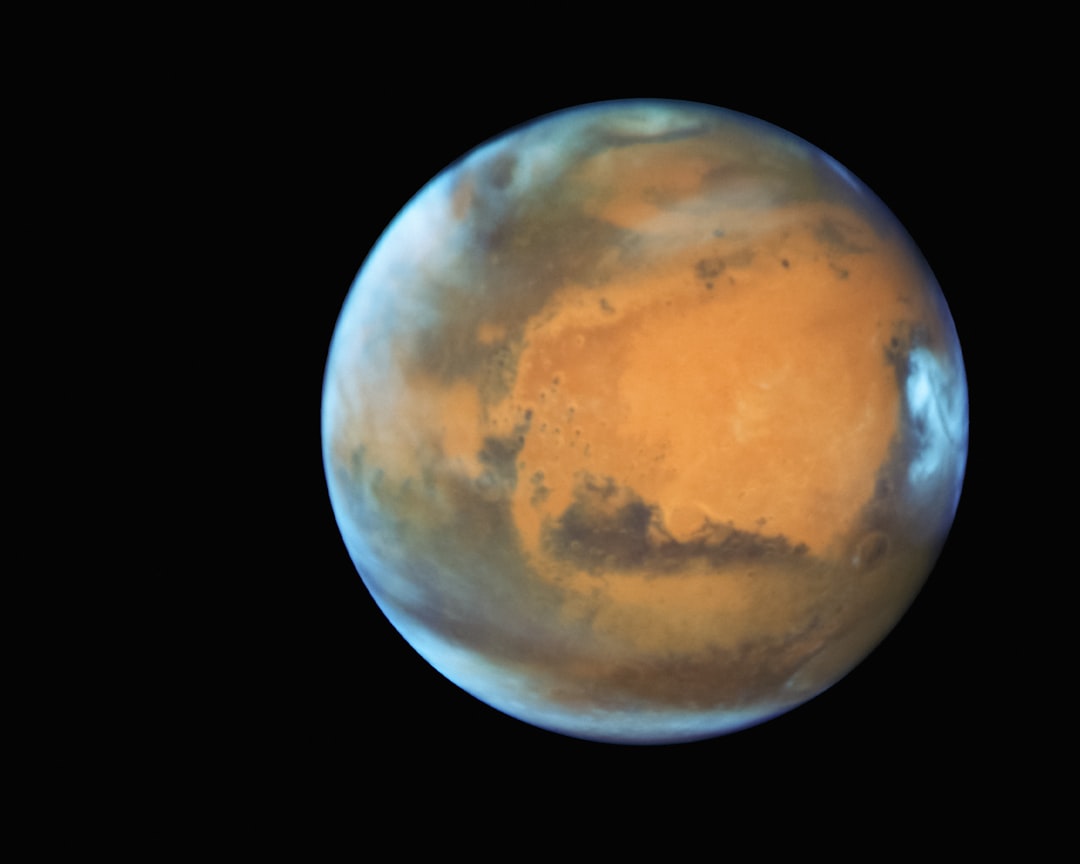
Mars is the fourth planet from the Sun, orbiting at an average distance of 228 million km (142 million miles), or 1.52 AU. Known as the "Red Planet" due to the iron oxide (rust) that permeates its soil and dust, Mars has captivated human imagination for millennia and today stands as the primary target of humanity's aspirations for interplanetary exploration and eventual settlement.
Mars bears striking surface similarities to Earth — it has towering volcanoes (including Olympus Mons, the largest volcano in the Solar System at roughly 22 km tall and 600 km wide), vast canyon systems (the Valles Marineris stretches over 4,000 km), ancient river channels, and polar ice caps composed of water ice and carbon dioxide frost. These features provide compelling evidence that Mars was once a warmer, wetter world — and potentially habitable. Its thin atmosphere and weak magnetic field, however, mean that any surface water today exists only as ice or transient briny flows.