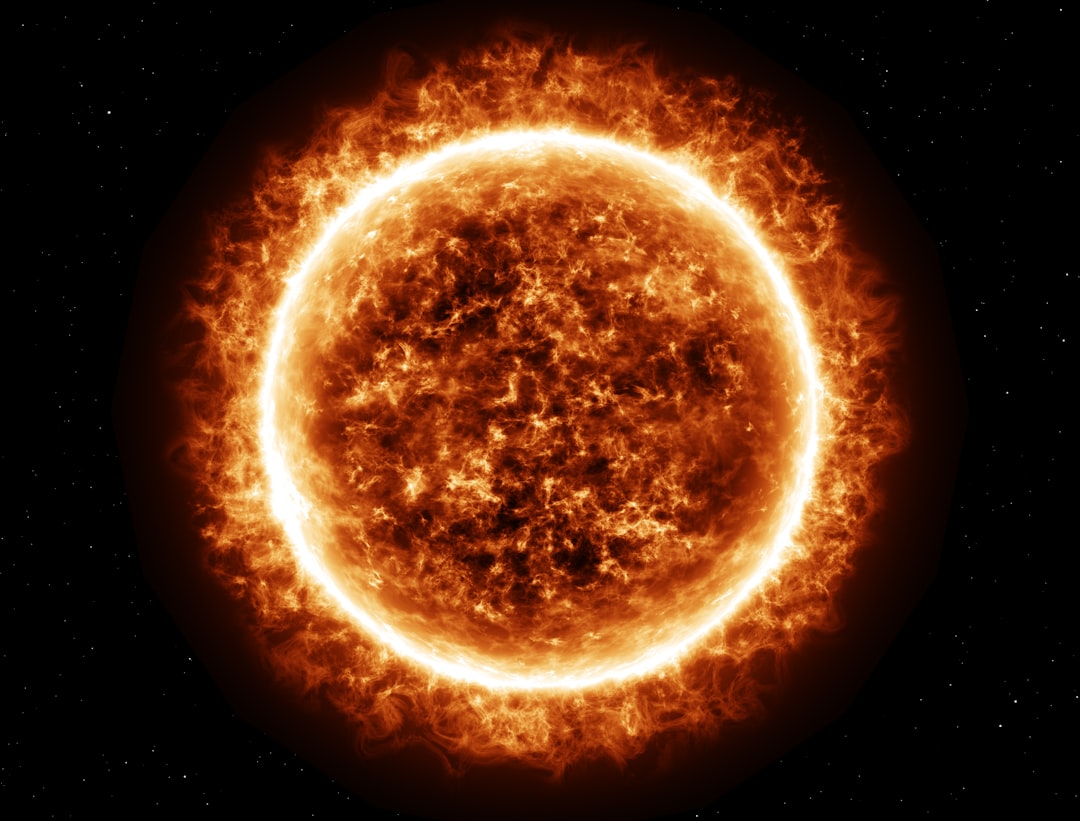
Snapping the Sun's Grand Magnetic Border at 0.3 AU: Solar Orbiter Delivers the Clearest View Yet of the Solar System's Largest Structure
Stretching across the entire solar system like a vast, rippling cosmic curtain, the Heliospheric Current Sheet (HCS) holds the distinction of being the single largest coherent structure in our solar system. Billions of kilometers wide and only a few thousand kilometers thick in places, this undulating sheet of charged particles marks the boundary where the Sun's magnetic field flips polarity — from north to south — and extends outward through interplanetary space. Despite its enormous scientific significance, detailed, close-range measurements of the HCS have historically been confined to observations made near Earth's orbit. Now, a landmark new study changes that in a dramatic fashion.
A research team led by Keiichi Ogasawara of the Southwest Research Institute (SwRI) has used the joint ESA/NASA Solar Orbiter mission to capture the HCS at just 0.3 AU — roughly one-third the distance from the Sun to Earth — delivering what scientists are calling the clearest, most compositionally detailed portrait of this structure ever assembled. The results, published in a new paper by Ogasawara and colleagues, are transforming our understanding of how the Sun's corona transitions into the solar wind that ultimately fills and shapes our entire planetary neighborhood.
What Is the Heliospheric Current Sheet?
To appreciate the significance of this discovery, it helps to understand what the HCS actually is and where it comes from. The Sun, like Earth, has a magnetic field — but unlike Earth's relatively stable dipole, the Sun's magnetic field is a writhing, dynamic entity that reverses polarity approximately every 11 years as part of the solar cycle. The HCS is born from this magnetic complexity: it is the surface in three-dimensional space where the Sun's outward magnetic field transitions from one polarity to another.
The HCS grows directly out of helmet streamers — enormous, bright, loop-like plasma structures visible in the Sun's outer atmosphere, or corona, that are particularly prominent during solar maximum. These streamers funnel plasma outward along the solar equatorial plane, forming the foundation of the current sheet. Because the Sun's magnetic axis is slightly tilted relative to its rotational axis, and because the solar corona is not uniform, the HCS takes on a distinctive warped, wavy shape sometimes described as resembling the undulating skirt of a ballerina — a description popularized by the late physicist John M. Wilcox.
Previous close-up studies of the HCS relied on instruments aboard spacecraft such as ESA/NASA's SOHO and NASA's Wind spacecraft, both of which operate near Earth at approximately 1 AU. At that distance, the solar wind has already traveled for days and interacted extensively with turbulence, wave-particle interactions, and the broader interplanetary medium. Observations at 0.3 AU, by contrast, offer a snapshot of the solar wind in a far more pristine state — closer to its source and less processed by the interplanetary environment.
Solar Orbiter's Historic Crossing
On April 13th, 2023, Solar Orbiter executed a precisely planned crossing of the HCS at 0.3 AU with its full instrument suite operating at maximum sensitivity. The spacecraft, a product of collaboration between the European Space Agency (ESA) and NASA, carries a suite of both remote-sensing and in-situ instruments specifically designed to study the Sun's corona and the solar wind at unprecedented proximity.
Among the instruments playing a starring role in this study was the Heavy Ion Sensor (SWA-HIS), part of the Solar Wind Analyser suite. SWA-HIS is capable of resolving the charge states and elemental abundances of heavy ions — particles far more massive than protons — with a level of detail that transforms the HCS from a simple magnetic boundary into a rich, multi-layered tapestry of physical processes. Rather than a flat magnetic divide, what Solar Orbiter encountered was more akin to a multi-lane highway of magnetic complexity, filled with alternating plasma pressures, compositional gradients, and magnetic anomalies.
"This is not just a line in space where the magnetic field flips. It's a structured, multi-layered environment with distinct plasma populations, embedded current systems, and compositional signatures that trace back to specific source regions on the Sun." — Keiichi Ogasawara, Southwest Research Institute
Key Discoveries: A Multi-Layered Magnetic World
Magnetic Reconnection at the Current Sheet Boundary
One of the first striking observations came just before Solar Orbiter reached the main body of the HCS. The spacecraft detected a sudden disappearance of strahls — fast, field-aligned beams of electrons that typically stream outward from the Sun along magnetic field lines. Simultaneously, solar wind protons in this region were traveling approximately 50 km/s faster than those in the surrounding solar wind.
This combination of strahl dropout and accelerated protons is a classic signature of magnetic reconnection — the explosive process by which oppositely directed magnetic field lines break and reconnect, converting magnetic energy into kinetic and thermal energy and launching bursts of plasma in the process. Magnetic reconnection is thought to be one of the key mechanisms energizing the solar corona and driving eruptions like solar flares and coronal mass ejections. Observing its signatures at just 0.3 AU, embedded within the HCS boundary layer, gives scientists a far less processed and more direct view of this fundamental process than has previously been possible.
Ionic Charge States: Stable Messengers from the Corona
Perhaps one of the most elegant findings of the study concerns what didn't change as Solar Orbiter traversed the magnetically turbulent HCS: the charge-state ratios of carbon and oxygen. These ratios — essentially a tally of how many electrons each ion has shed — are established deep in the solar corona, within approximately 1–2 solar radii of the Sun's surface. This location is known as the freeze-in height.
At the freeze-in height, the solar wind plasma has expanded and cooled to the point where collisions between electrons and ions become so infrequent that the charge states are effectively "frozen in" — they can no longer easily change by capturing or losing electrons. This means that ionic charge-state ratios serve as fossil records of coronal conditions, preserving information about the temperature and density of the plasma at the point of its origin, millions of kilometers closer to the Sun.
The remarkable stability of these ratios across the HCS, even amid the magnetic chaos of the current sheet crossing, confirms that the reconnection events and magnetic turbulence occurring within the HCS do not alter the fundamental ionic memory of the plasma. This is a critically important finding: it means researchers can use these ratios as reliable tracers to map the HCS's plasma populations back to their specific source regions in the corona — a kind of cosmic fingerprinting that survives even the most turbulent magnetic environments.
The Iron-to-Oxygen Ratio and the Role of Gravity
While charge-state ratios proved stable, the elemental abundance ratios told a different and equally compelling story. As Solar Orbiter approached the center of the HCS, the team observed a sharp drop in the iron-to-oxygen (Fe/O) ratio — a finding with deep implications for how the solar wind is loaded with material.
To understand why this matters, one must consider the concept of First Ionization Potential (FIP). Elements with a low FIP — meaning they require relatively little energy to lose their first electron — are preferentially picked up and accelerated by the solar wind. Iron, with one of the lowest FIPs of any common element, is typically enhanced in the solar wind relative to its photospheric abundance. Oxygen, by contrast, has a much higher FIP and is not preferentially enhanced. This FIP effect is a well-known but still incompletely understood feature of solar wind composition.
The drop in Fe/O within the HCS, which settled toward values closer to those found in the Earth's photosphere rather than typical solar wind, points to an unexpected culprit: gravity. Heavy ions like iron, trapped for extended periods within the large closed magnetic loops of helmet streamers near the Sun, gradually sink toward the solar surface under gravitational influence before the plasma is eventually released into the solar wind. This gravitational settling depletes iron relative to lighter elements, producing the photospheric-like abundance signature that Solar Orbiter detected. It is a striking reminder that even at the scale of the solar system's largest structure, the most fundamental of forces — gravity — leaves its fingerprint on the plasma composition.
Oxygen Temperature Spikes and Alfvén Cyclotron Wave Heating
The temperature behavior of oxygen ions within the HCS provided yet another window into the physics operating at this magnetic boundary. Because oxygen has not had sufficient time to thermally equilibrate with surrounding protons at the relatively close distance of 0.3 AU, measuring its temperature at this point captures a record of the heating processes it has undergone far closer to the Sun.
In a thermally equilibrated plasma, ion temperatures would scale proportionally with mass. Since oxygen is approximately 16 times heavier than a proton, one would expect its temperature to be 16 times higher if heating were purely mass-proportional — a threshold known as the super-mass-proportional limit. Surprisingly, Solar Orbiter observed oxygen temperatures exceeding this limit at multiple locations within the HCS, indicating a preferential and selective heating process at work.
These oxygen temperature spikes correlated positively with increases in the O⁷⁺/O⁶⁺ charge ratio — indicating higher local electron temperatures — but correlated negatively with the equivalent carbon charge ratio, suggesting that carbon was being systematically deprived of heat. The leading explanation for this selective heating is Alfvén cyclotron waves: electromagnetic waves that propagate along magnetic field lines and resonate with specific ions at their characteristic gyration frequencies. These waves deposit energy preferentially into ions with particular charge-to-mass ratios, heating oxygen perpendicular to the magnetic field while alpha particles (helium nuclei) absorb the wave energy that would otherwise reach carbon ions, effectively starving carbon of a temperature boost.
This mechanism has long been theorized as a driver of differential ion heating in the corona and solar wind, but observing its signatures so close to the Sun — embedded within the unique magnetic environment of the HCS — provides some of the most compelling in-situ evidence for it yet recorded.
Why 0.3 AU Matters: The Case for Closer Observations
The decision to study the HCS at 0.3 AU rather than at Earth's orbital distance is far more than a matter of convenience. At 1 AU, the solar wind has traveled for an average of three to four days since leaving the Sun, during which time it has been buffeted by waves, turbulence, and interactions with other solar wind streams. Many of the subtle compositional and thermal signatures that betray the plasma's origins have been blurred or erased entirely by this journey.
At 0.3 AU, the solar wind is much younger — only hours old — and the signatures imprinted upon it by its source region in the corona are still sharp and readable. This is what makes Solar Orbiter's crossing so scientifically valuable: it is the equivalent of examining a biological specimen fresh rather than after days of deterioration. The multi-layered structure, the compositional gradients, the magnetic reconnection signatures — all of these features would be far harder, if not impossible, to resolve at greater distances.
- Magnetic reconnection signatures detected via strahl dropout and proton acceleration at the HCS boundary
- Stable ionic charge-state ratios for carbon and oxygen, preserving coronal temperature records across the magnetic boundary
- Depleted iron-to-oxygen ratios near the HCS center, reflecting gravitational settling within closed coronal loops
- Super-mass-proportional oxygen heating linked to Alfvén cyclotron wave interactions within the HCS
- Anti-correlated carbon and oxygen heating, suggesting energy competition mediated by alpha particles
Looking Ahead: Solar Orbiter, Parker Solar Probe, and the Future of Heliospheric Science
Solar Orbiter is not the only spacecraft pushing the boundaries of close solar observation. NASA's Parker Solar Probe, which has already dipped within 0.1 AU of the Sun's surface — closer than any spacecraft in history — is gathering complementary data that, when combined with Solar Orbiter's measurements, will paint an increasingly detailed picture of the inner heliosphere. Together, these missions represent a golden age of heliospheric science, providing in-situ measurements in regions that were, until recently, entirely beyond reach.
Future crossings of the HCS at even closer distances, combined with the remote-sensing capabilities of Solar Orbiter's imaging instruments, could allow scientists to directly connect specific surface features on the Sun — such as individual helmet streamers or active regions — to the plasma populations detected in the HCS. This kind of end-to-end tracing of solar wind material, from its birth in the corona to its passage through the HCS and ultimately to its interaction with planetary magnetospheres, is one of the grand challenges of modern space science.
Understanding how the HCS behaves and evolves also has practical implications for space weather forecasting. The HCS is associated with regions of enhanced solar wind variability, and crossings of the current sheet by Earth's magnetosphere can trigger geomagnetic disturbances. Improved models of HCS structure, informed by close-range measurements like those from Solar Orbiter, could enhance our ability to predict these events and protect vulnerable infrastructure — from power grids to satellites to astronauts in deep space. For more on ongoing heliospheric research, the NASA Heliophysics Division maintains an extensive archive of mission data and scientific updates.
As we collect more and more data closer to the Sun, we will begin to unlock an ever-richer understanding of how complex our nearest star truly is — and how that complexity ripples outward to shape the environment of every planet, moon, and spacecraft in the solar system.
This study by Ogasawara and his team at SwRI, enabled by the extraordinary capabilities of Solar Orbiter, is a powerful demonstration of what becomes possible when we dare to look closer. The Sun's grand magnetic border is no longer a distant, blurred feature — it is, for the first time, a place we can read in full detail, layer by layer, ion by ion, and wave by wave. The story it tells is richer, stranger, and more beautiful than we had imagined.