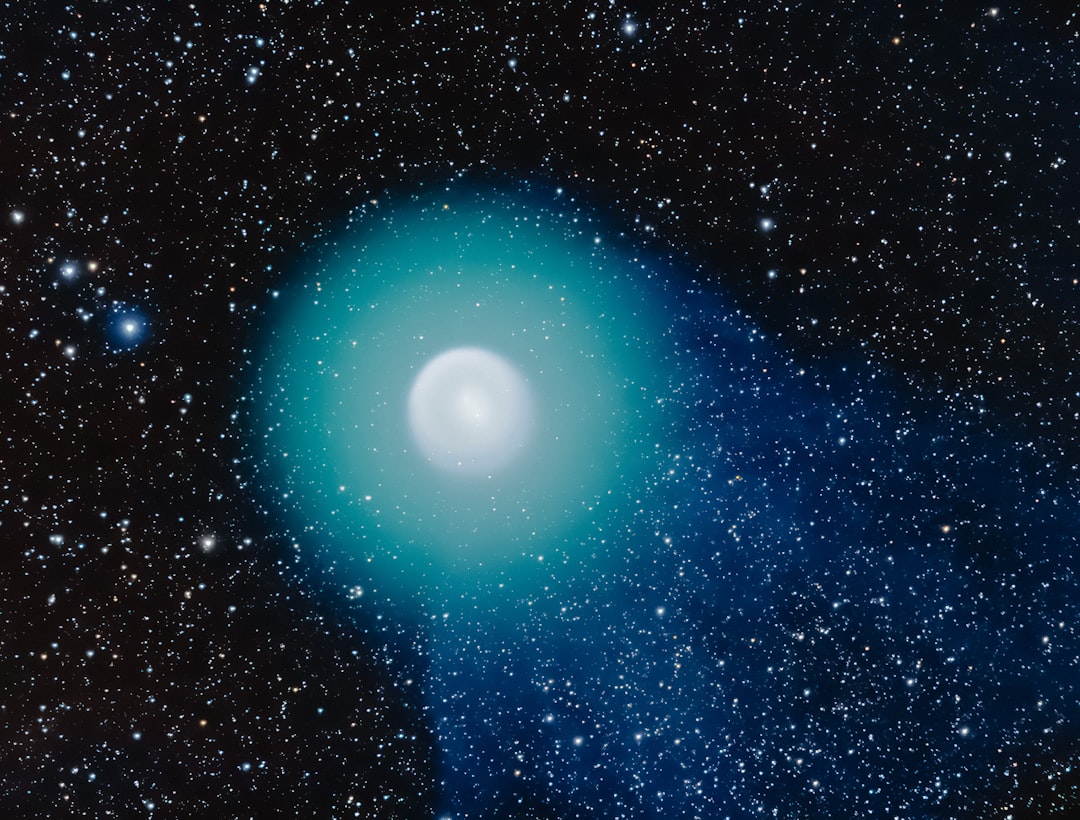
Some Comets are Naked, and One Just Got Caught Photo-Bombing
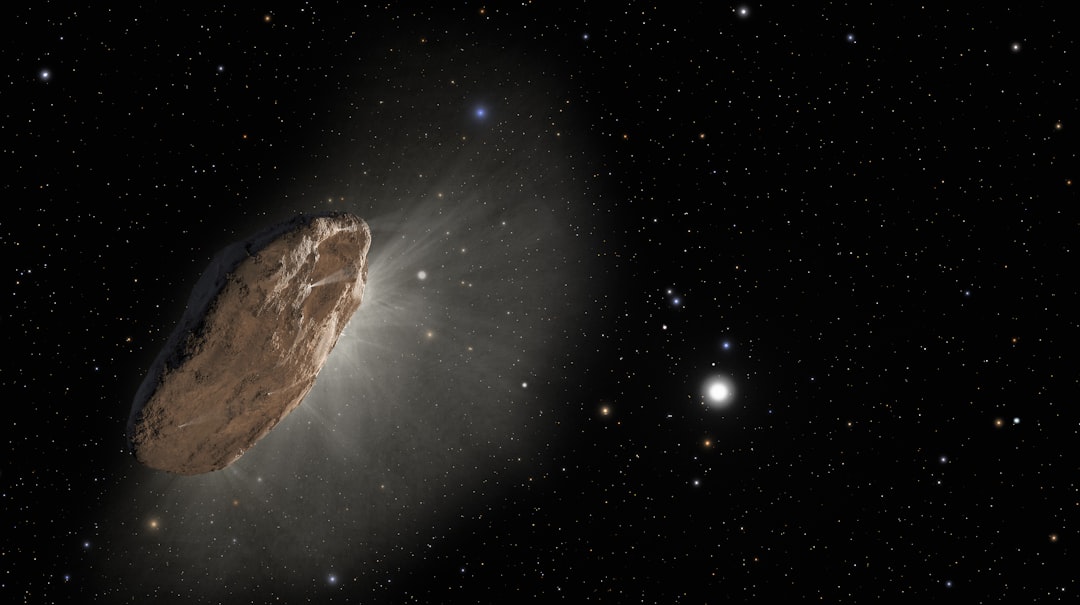
Observing comets is a deceptively tricky business. These icy wanderers of the outer Solar System are easiest to spot when they venture close to the Sun — yet that same proximity is precisely what makes them scientifically frustrating. As a comet approaches our star, solar radiation heats its surface, sublimating frozen gases and dust in a process that generates a glowing coma: a diffuse, often vast envelope of gas and dust that can stretch tens of thousands of kilometers wide. That coma shrouds the comet's nucleus — the solid body at the heart of the object — and makes it nearly impossible to study the surface directly.
For planetary scientists trying to understand what comets are truly made of, this is a major obstacle. The nucleus is where all the primordial information is locked away, preserved from the dawn of the Solar System some 4.5 billion years ago. Studying it requires catching comets when they are still far from the Sun, cold and quiet, before the coma develops — and that demands extraordinarily powerful telescopes capable of detecting faint objects at tremendous distances.
Enter the Subaru Telescope
One such instrument is the National Astronomical Observatory of Japan's (NAOJ) Subaru Telescope, perched atop the dormant shield volcano Mauna Kea on the Big Island of Hawaiʻi at an altitude of 4,139 meters. Completed in 1998 and boasting an impressive 8.2-meter primary mirror, Subaru is one of the world's premier optical-infrared telescopes. Its high-altitude location above much of Earth's atmosphere — and far from the light pollution of major cities — makes it ideal for detecting the faint signatures of distant Solar System bodies.
Over its decades of operation, the Subaru Telescope and its suite of cameras, including the original Subaru Prime Focus Camera (Suprime-Cam) and the more modern Hyper Suprime-Cam (HSC), have generated a vast and richly detailed archive of astronomical images. This archive is a treasure trove for researchers, containing data that, in many cases, was collected for one purpose but turns out to be invaluable for entirely different lines of inquiry. Hidden within those accumulated gigabytes of imaging data may lie discoveries that no one has yet recognized.
A team of Japanese scientists recently mined precisely this archive, hunting for previously unanalyzed observations of a particular comet. Their results appear in a paper published in the Publications of the Astronomical Society of Japan, titled "Opposition effect of comet 28P/Neujmin observed with Subaru Hyper Suprime-Cam." The lead author is Takafumi Ootsubo, from the Planetary Exploration Research Center at the Chiba Institute of Technology in Japan.
Meet the 'Naked' Comet: 28P/Neujmin
Comet 28P/Neujmin is not your average comet. Discovered in 1913 by Soviet astronomer Sergei Ivanovich Neujmin, it travels on an elongated orbit that carries it around the Sun roughly once every 18 years. With a nucleus approximately 21 kilometers across, it is one of the largest known members of the Jupiter-family comets — a dynamically distinct population of short-period comets whose orbits have been shaped by gravitational interactions with Jupiter over millions of years.
What makes 28P/Neujmin especially fascinating to astronomers, however, is not its size or its orbital history — it is its extraordinary lack of activity. At large heliocentric distances, the comet is essentially bare: it displays virtually no coma whatsoever, earning it the informal designation of a "naked" comet. This places it in a rare and scientifically precious category. Without the confounding veil of outgassing material, astronomers can observe the nucleus directly, studying its surface properties in much the same way they would examine an asteroid.
"We present an observational study of the nucleus of comet 28P/Neujmin at a heliocentric distance exceeding 10 au, where coma contamination is effectively minimized." — Ootsubo et al., Publications of the Astronomical Society of Japan
Ten astronomical units (au) — ten times the distance between Earth and the Sun — is well beyond the orbit of Saturn. At such distances, solar heating is so feeble that even volatile-rich comets often remain dormant. For 28P/Neujmin, which appears to have a surface relatively depleted of easily sublimated ices, this means that observations at these distances yield a clean, uncontaminated view of the solid nucleus beneath.
Blurring the Line Between Comets and Asteroids
The scientific interest in 28P/Neujmin extends well beyond its photogenic nakedness. The comet sits at a fascinating conceptual frontier: it closely resembles an asteroid in many of its observable properties. This makes it a compelling test case for one of the most actively debated questions in modern planetary science — just how different are comets and asteroids, really?
The traditional picture, dominant for most of the 20th century, drew a clean line between the two populations. Comets were understood to be icy bodies that formed in the cold outer reaches of the Solar System — in the Kuiper Belt and the more distant Oort Cloud — and were composed predominantly of frozen water, carbon dioxide, methane, and other volatiles mixed with dust. Asteroids, by contrast, were rocky or metallic bodies concentrated in the inner Solar System, primarily within the Main Asteroid Belt between Mars and Jupiter, and were thought to be comparatively dry and inert.
Recent decades have complicated this tidy picture enormously. Spacecraft missions such as ESA's Rosetta mission to comet 67P/Churyumov–Gerasimenko and NASA's Dawn mission to asteroid Vesta and dwarf planet Ceres have revealed unexpected complexity on both sides of the traditional divide.
- Some asteroids, particularly in the C-type (carbonaceous) and D-type categories, contain hydrated minerals — evidence that water was once present and chemically active on their surfaces.
- Signs of hydrated silicates have been tentatively detected on cometary nuclei, suggesting that liquid water may have been present at some point in their history.
- A growing class of objects known as active asteroids or main-belt comets display comet-like comae while residing on asteroid-like orbits, confounding classification entirely.
- Jupiter Trojan asteroids — which share Jupiter's orbit at the L4 and L5 Lagrange points — are spectrally almost identical to Jupiter-family comets, hinting at a shared origin in the outer Solar System.
"Traditional models of the solar system formation postulated that 'icy' comets and 'rocky' asteroids possess substantially different physical properties and distinct origins. Some asteroids contain water and hydrated minerals, while signs of hydrated silicates have been detected on comet nuclei." — Ootsubo et al.
The Opposition Effect: A Diagnostic Tool
To probe the surface properties of 28P/Neujmin in detail, the research team focused on a specific observational phenomenon known as the opposition effect (OE). This is a well-documented surge in the brightness of airless, atmosphereless bodies — asteroids, cometary nuclei, planetary moons — when they are observed at very small phase angles: the angle between the Sun, the observed object, and the telescope.
When an object is in opposition — positioned such that the observer sees it from almost exactly the same direction as the incoming sunlight — shadows cast by surface grains, rocks, and irregularities fall directly behind those features, completely hidden from view. The result is an apparent brightening of the entire visible surface that goes well beyond what simple geometry would predict. This effect was first systematically studied in the context of planetary surfaces and has since become a powerful diagnostic tool in planetary science.
The shape of the opposition surge — how rapidly and how strongly the brightness increases as the phase angle approaches zero — is sensitive to the microphysical properties of the surface. Key factors include:
- Albedo — how reflective the surface material is.
- Grain size and packing density — how tightly the surface particles are packed together.
- Porosity — the fraction of empty space between surface grains, both at microscopic and macroscopic scales.
- Surface roughness — large-scale texture that influences shadowing at phase angles away from opposition.
By analyzing the magnitude-phase curve — a plot of the object's brightness as a function of phase angle — astronomers can classify and compare the surface textures of different Solar System bodies with remarkable precision. This allows them to determine which taxonomic group of asteroids a cometary nucleus most closely resembles, providing indirect insight into the object's composition and formation history.
The Accidental Discovery: A Photo-Bombing Comet
The Subaru Telescope's archival images did not contain planned, dedicated observations of 28P/Neujmin. Instead, the comet had wandered into the field of view of the Subaru Hyper Suprime-Cam (HSC) during imaging runs aimed at entirely different targets — in effect, photo-bombing the observations. HSC is one of the world's most capable wide-field cameras, with a 1.77-square-degree field of view and an array of 116 scientific CCDs, making it ideally suited for capturing large swaths of sky in a single exposure. Because of this wide field, background objects — including Solar System bodies on slow, predictable trajectories — frequently appear in archival data without having been deliberately targeted.
When the team searched the Subaru HSC archive, they found that the comet had been serendipitously imaged at a heliocentric distance of more than 10 astronomical units, well beyond the orbit of Saturn, and at a particularly favorable geometry for measuring the opposition effect. This was a rare observational opportunity that would have been extremely difficult to arrange deliberately, given the narrow window of phase angles required for opposition effect measurements.
Key Findings: A Fluffy Impostor
The analysis of the archival HSC data yielded a striking set of results. The color of 28P/Neujmin's nucleus — that is, how its reflectivity varies across different wavelengths of light — closely matches that of D-type asteroids, the reddest and most primitive class of asteroids in the taxonomic system. D-type asteroids are thought to be rich in organic compounds and anhydrous silicates, and they are most commonly found among the Jupiter Trojans and in the outer Main Belt. This spectral similarity between 28P/Neujmin and D-type asteroids is consistent with earlier spectroscopic studies of the comet and strengthens the hypothesis that Jupiter-family comets and Jupiter Trojan asteroids share a common reservoir of origin in the outer Solar System.
However — and this is the crucial finding — while the comet looks like a D-type asteroid in terms of color and spectral signature, its surface microstructure tells a distinctly different story. The opposition effect parameters derived from the HSC data reveal that the surface of 28P/Neujmin has a significantly different grain-packing density and small-scale porosity compared to both C-type and D-type asteroids. Specifically, the comet's surface appears to be far more loosely packed — fluffier, in the parlance of planetary scientists — than its asteroid counterparts.
"The Subaru HSC observations suggest that, although the nucleus color resembles that of D-type asteroids, the surface microstructure of comet 28P's nucleus likely differs from those of C- and D-type asteroids." — Ootsubo et al.
This distinction is highly significant. It implies that even when a comet and an asteroid have formed from broadly similar raw materials — in similar environments of the early outer Solar System — the subsequent evolution of their surfaces can diverge substantially. Cometary nuclei, repeatedly subjected to cycles of subtle outgassing activity and the slow loss of volatile material from their surfaces, may develop a porous, loosely consolidated regolith that is physically quite distinct from the more compacted surfaces of asteroids. This fluffy texture may be a diagnostic fingerprint of cometary surfaces, regardless of their compositional similarities to certain asteroid classes.
Implications for Solar System Formation and Evolution
The broader implications of this research extend well beyond the specific case of 28P/Neujmin. The increasingly blurred distinction between comets and asteroids has profound consequences for our understanding of how the Solar System formed and evolved over its 4.5-billion-year history.
Current leading models of Solar System formation — particularly the Nice model and its successors — propose that the giant planets underwent significant orbital migration in the early Solar System, dramatically reshuffling the populations of small bodies in their gravitational wake. In such scenarios, objects that we now observe as Jupiter Trojans, outer Main Belt asteroids, and Jupiter-family comets may all have originated from the same primordial reservoir of icy planetesimals in the outer Solar System — what is sometimes called the trans-Neptunian disk. Some of these objects were scattered inward and captured into their current orbits, while others remained in place or were flung outward.
If comets like 28P/Neujmin and D-type asteroids did indeed form in the same region of the primordial solar nebula, then understanding why their surfaces are now different — despite their shared spectral heritage — is a key step in reconstructing the history of small-body processing and evolution across billions of years. Future missions, such as NASA's Lucy spacecraft, currently en route to explore multiple Jupiter Trojan asteroids, may provide crucial complementary data to help resolve these questions.
The Power of Archival Science
One of the most compelling aspects of this study is its methodological lesson: the profound scientific value that can be unlocked by systematically mining large astronomical archives. The Subaru Telescope was not pointed at 28P/Neujmin with the express purpose of studying its opposition effect. The comet simply drifted across pre-existing fields of view, leaving its faint photometric signature on images taken for entirely different programs. Yet those incidental observations turned out to contain enough information to reveal fine details of the comet's surface texture at a heliocentric distance that would be extremely challenging to target with a dedicated observing campaign.
As next-generation survey facilities — including the Vera C. Rubin Observatory (formerly