In a groundbreaking achievement that marks a pivotal moment in our understanding of cosmic phenomena, an international team of astronomers has successfully traced the origin of repeating Fast Radio Bursts (FRBs) to a binary star system for the first time. Using China's colossal Five-hundred-meter Aperture Spherical Telescope (FAST), affectionately known as the "China Sky Eye," researchers monitored a specific radio source for nearly two years, ultimately revealing that FRB 20220529 emanates from a binary system located in a distant disk galaxy approximately 2.2 to 2.4 billion light-years from Earth. This discovery, published in the prestigious journal Science on January 15th, fundamentally challenges long-held assumptions about the cosmic origins of these mysterious and powerful radio emissions.
The implications of this research extend far beyond a single detection. By identifying a binary star system as the source, astronomers have opened an entirely new chapter in FRB research, one that could explain why certain FRBs repeat while others appear as singular events. Led by Dr. Ye Li of the Purple Mountain Observatory and the University of Science and Technology of China, the research team's meticulous observations have provided the first definitive evidence linking these enigmatic bursts to stellar companions, potentially solving one of modern astronomy's most perplexing mysteries.
The Enigmatic Nature of Fast Radio Bursts
Since the detection of the Lorimer Burst in 2007—the first confirmed FRB—astronomers have grappled with understanding these extraordinary cosmic phenomena. These rapid bursts of radio waves represent some of the most energetic events in the universe, releasing in mere milliseconds the equivalent energy that our Sun produces over several days. The sheer power and brevity of these events have captivated the astronomical community and sparked intense scientific debate about their origins.
What makes FRBs particularly intriguing is their diversity. While the vast majority of detected FRBs are one-time events, disappearing as quickly as they appear, a small subset exhibits repeating behavior. These repeating FRBs have become the focus of intensive study because they offer astronomers the rare opportunity to conduct follow-up observations and gather detailed data about their source environments. The NASA Swift mission and other space-based observatories have contributed to cataloging these events, but ground-based radio telescopes like FAST have proven invaluable for continuous monitoring.
Over the years, scientists have proposed numerous theories to explain FRBs, ranging from magnetars (neutron stars with extraordinarily powerful magnetic fields) and supermassive black holes to more exotic explanations involving hypothetical cosmic strings or even, speculatively, advanced extraterrestrial communications. The challenge has been gathering sufficient observational evidence to distinguish between these competing hypotheses.
Revolutionary Observations with the China Sky Eye
The Five-hundred-meter Aperture Spherical Telescope represents a triumph of modern engineering and astronomical ambition. Nestled in a natural depression in China's Guizhou Province, FAST is the world's largest single-dish radio telescope, surpassing even the famous Arecibo Observatory (before its collapse in 2020) in collecting area. Its immense size provides unparalleled sensitivity to faint radio signals from the distant universe, making it the ideal instrument for studying repeating FRBs.
Since 2020, FAST has been conducting a dedicated FRB Key Science Program, co-led by Professor Bing Zhang, Chair Professor of Astrophysics and Founding Director of the Hong Kong Institute for Astronomy and Astrophysics at the University of Hong Kong. This systematic monitoring program has allowed astronomers to track repeating FRBs with unprecedented continuity and precision. The program's success demonstrates the value of long-term, sustained observations in astronomy—sometimes the most significant discoveries require patience and persistence rather than a single dramatic observation.
For FRB 20220529, the FAST team conducted observations spanning 17 months, accumulating a rich dataset that captured not just the radio bursts themselves but also subtle changes in the signal's properties over time. This extended baseline proved crucial for detecting the rotation measure flare that would ultimately reveal the binary nature of the source.
The Telltale Rotation Measure Flare
The breakthrough came when the research team identified a rare and dramatic phenomenon in late 2023: a rotation measure (RM) flare. To understand the significance of this observation, it's essential to grasp what rotation measure represents in radio astronomy. When radio waves travel through magnetized plasma—ionized gas permeated by magnetic fields—the plane of polarization of the waves rotates. This effect, known as Faraday rotation, provides astronomers with a powerful diagnostic tool for probing the magnetic environment between Earth and a distant radio source.
Under normal circumstances, FRBs exhibit remarkably stable polarization properties with near-perfect linear polarization. However, Dr. Li and his colleagues observed something extraordinary: the rotation measure suddenly increased by more than a factor of one hundred, then rapidly declined over approximately two weeks, returning to baseline levels. This dramatic, short-lived change could only be explained by a significant alteration in the magnetic environment near the FRB source.
"Near the end of 2023, we detected an abrupt RM increase by more than a factor of a hundred. The RM then rapidly declined over two weeks, returning to its previous level. We call this an 'RM flare,'" explained Dr. Ye Li, lead author of the study.
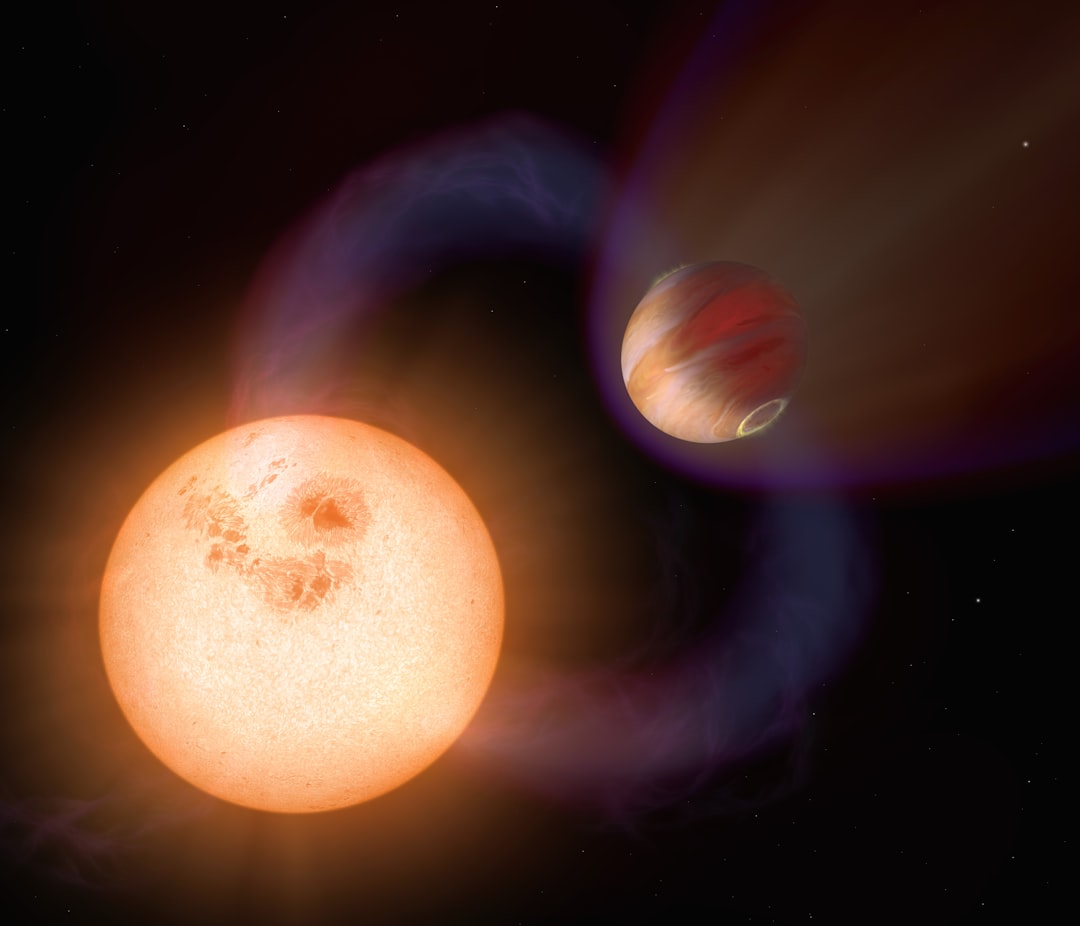
The team concluded that this RM flare was most consistent with a dense cloud of magnetized plasma crossing the line of sight between FAST and the FRB source. But what could produce such a cloud? The answer pointed directly to stellar activity: a coronal mass ejection (CME) from a companion star. On our own Sun, CMEs are massive eruptions of plasma and magnetic field that can affect space weather throughout the solar system. The detection of what appears to be a CME signature in the FRB data provided the smoking gun evidence for a binary system.
Unveiling the Binary System Architecture
Based on their observations, the research team has constructed a compelling picture of the FRB 20220529 system. The evidence strongly suggests a binary configuration consisting of a magnetar—a neutron star possessing an extraordinarily powerful magnetic field—paired with a more ordinary star similar to our Sun. This arrangement creates the perfect conditions for generating repeating FRBs through stellar interactions.
Professor Bing Zhang elaborated on the significance of this finding:
"FRB 220529A was monitored for months and initially appeared unremarkable. Then, after a long-term observation for 17 months, something truly exciting happened. This finding provides a definitive clue to the origin of at least some repeating FRBs. The evidence strongly supports a binary system containing a magnetar—a neutron star with an extremely strong magnetic field, and a star like our Sun."
While the immense distance to the source galaxy—spanning billions of light-years—prevents direct optical observation of the companion star, its presence is revealed through the radio observations. The detection was made possible through collaborative efforts using not only FAST but also the Parkes Observatory radio telescope in Australia, demonstrating the power of international cooperation in modern astronomy.
The magnetar component of this binary system is particularly fascinating. Magnetars possess magnetic fields that can reach intensities of 10^14 to 10^15 Gauss—thousands of times stronger than typical neutron stars and trillions of times stronger than Earth's magnetic field. These extreme magnetic environments can accelerate particles to relativistic speeds and generate the intense radio emission observed in FRBs. When coupled with material and magnetic interactions from a companion star, the conditions become ideal for producing repeating bursts.
Implications of the Binary Model
The discovery has profound implications for our understanding of FRB diversity. The research supports a unified physical model recently proposed by Professors Zhang and Wu, which suggests that all repeating FRBs may originate from magnetars interacting with binary companions. This interaction model elegantly explains several puzzling features of repeating FRBs:
- Repetition Mechanism: The continuous or periodic interaction between the magnetar and its companion provides an ongoing source of energy and material that can trigger multiple FRB events, explaining why some sources repeat while isolated magnetars might produce only single bursts
- Environmental Complexity: Binary systems naturally create complex magnetic and plasma environments that can modulate the properties of radio bursts, accounting for the varied characteristics observed in different FRBs
- Temporal Variability: Stellar activity cycles in the companion star, such as CMEs and stellar winds, introduce time-variable effects that can explain changes in FRB properties over months or years
- Energy Budget: The gravitational and magnetic interactions in close binary systems provide ample energy to power the repeated, intense radio emissions without requiring exotic physics
Technological Achievements and Observational Challenges
This discovery underscores the critical importance of sustained, high-sensitivity observations in modern astronomy. Co-author Professor Xuefeng Wu of the Purple Mountain Observatory emphasized this point: "This discovery was made possible by the persevering observations using the world's best telescopes and the tireless work of our dedicated research team."
The success of this research relied on several key technological and methodological factors. FAST's enormous collecting area provides sensitivity that allows detection of subtle changes in radio signal properties that might be missed by smaller telescopes. The dedicated monitoring program ensured regular observations over an extended period, creating the temporal baseline necessary to detect rare events like the RM flare. Additionally, the collaboration with Parkes Observatory provided crucial confirmation and additional data, demonstrating how complementary observations from different hemispheres strengthen scientific conclusions.
The challenges of FRB research are considerable. These bursts are unpredictable, brief, and originate from cosmological distances where detailed imaging is impossible. Astronomers must rely on indirect signatures—changes in polarization, dispersion measures, and temporal patterns—to infer the nature of source environments. The detection of the RM flare in FRB 20220529 represents exactly this kind of detective work, piecing together evidence from subtle signal variations to construct a picture of an invisible stellar system billions of light-years away.
Future Directions in FRB Research
This breakthrough opens numerous avenues for future investigation. With premier radio observatories like FAST, Parkes, and the Square Kilometre Array (currently under construction) continuously monitoring repeating FRBs, astronomers are poised to determine just how common binary systems are as FRB sources. Key questions that remain include:
- Binary System Prevalence: What fraction of repeating FRBs originate from binary systems versus isolated magnetars or other sources?
- Companion Star Types: Do FRB-producing binary systems preferentially involve certain types of companion stars, or can they form with various stellar partners?
- Non-Repeating FRBs: If repeating FRBs come from binary systems, what produces the much more common non-repeating FRBs? Are they from isolated magnetars, or do they represent different phases of binary evolution?
- Burst Triggering Mechanisms: What specific interactions between the magnetar and companion star trigger individual FRB events? Is it stellar wind interaction, CME impacts, or orbital dynamics?
The research team plans to continue monitoring FRB 20220529 and other repeating sources to gather additional RM flare detections. Multiple observations of such events could reveal patterns related to orbital periods or stellar activity cycles, providing even stronger constraints on the binary system properties. Furthermore, coordinated observations across multiple wavelengths—from radio to X-ray—could capture the full picture of these complex stellar interactions.
Advanced facilities like the Very Large Array in New Mexico and the forthcoming Square Kilometre Array will contribute complementary observations with higher spatial resolution and broader frequency coverage. These capabilities will enable astronomers to study FRB host galaxies in greater detail and potentially identify optical or infrared counterparts to FRB sources, even at cosmological distances.
Broader Significance for Astrophysics
Beyond solving the specific mystery of FRB origins, this research demonstrates the power of time-domain astronomy—the study of how astronomical objects change over time. Many of the most exciting discoveries in modern astrophysics come from monitoring the sky continuously and detecting transient or variable phenomena. FRBs represent just one example; others include gravitational wave events, supernova explosions, and tidal disruption events.
The identification of binary systems as FRB sources also connects to broader questions about stellar evolution and compact object formation. Understanding how magnetars end up in binary systems with ordinary stars requires knowledge of supernova physics, binary star evolution, and the survival of companions through violent stellar deaths. Each FRB detection thus becomes a probe of these fundamental astrophysical processes.
Moreover, FRBs serve as unique tools for studying the intergalactic medium—the diffuse gas that fills the space between galaxies. As FRB radio waves travel across billions of light-years, they interact with every electron along the path, encoding information about the distribution of matter in the universe. By combining FRB observations with models of their source environments (now better understood thanks to discoveries like this), astronomers can more accurately use FRBs to map the cosmic web and study the evolution of baryonic matter across cosmic time.
The success of the China Sky Eye in making this discovery also highlights the growing capabilities of international astronomy infrastructure and the importance of global scientific collaboration. As facilities like FAST, the Square Kilometre Array, and next-generation space telescopes come online, our ability to monitor the universe continuously and sensitively will only increase, promising more groundbreaking discoveries in the years ahead.
This definitive evidence that at least some FRBs originate in binary star systems marks not an ending but a beginning—the start of a new era in understanding these cosmic enigmas and the extreme physics that produces them. As monitoring programs continue and more RM flares are detected, the full diversity of FRB sources will gradually come into focus, revealing the rich tapestry of high-energy astrophysical phenomena in our universe.