A team of astronomers working with the James Webb Space Telescope (JWST) have made a groundbreaking discovery that sheds new light on the formation of supermassive black holes in the early universe. The researchers found a little red dot (LRD) galaxy, CANUCS-LRD-z8.6, that hosts an actively growing supermassive black hole just 570 million years after the Big Bang. This finding, published in Nature Communications, challenges our current understanding of black hole and galaxy formation and opens up exciting new avenues for research.
The Puzzle of Little Red Dots
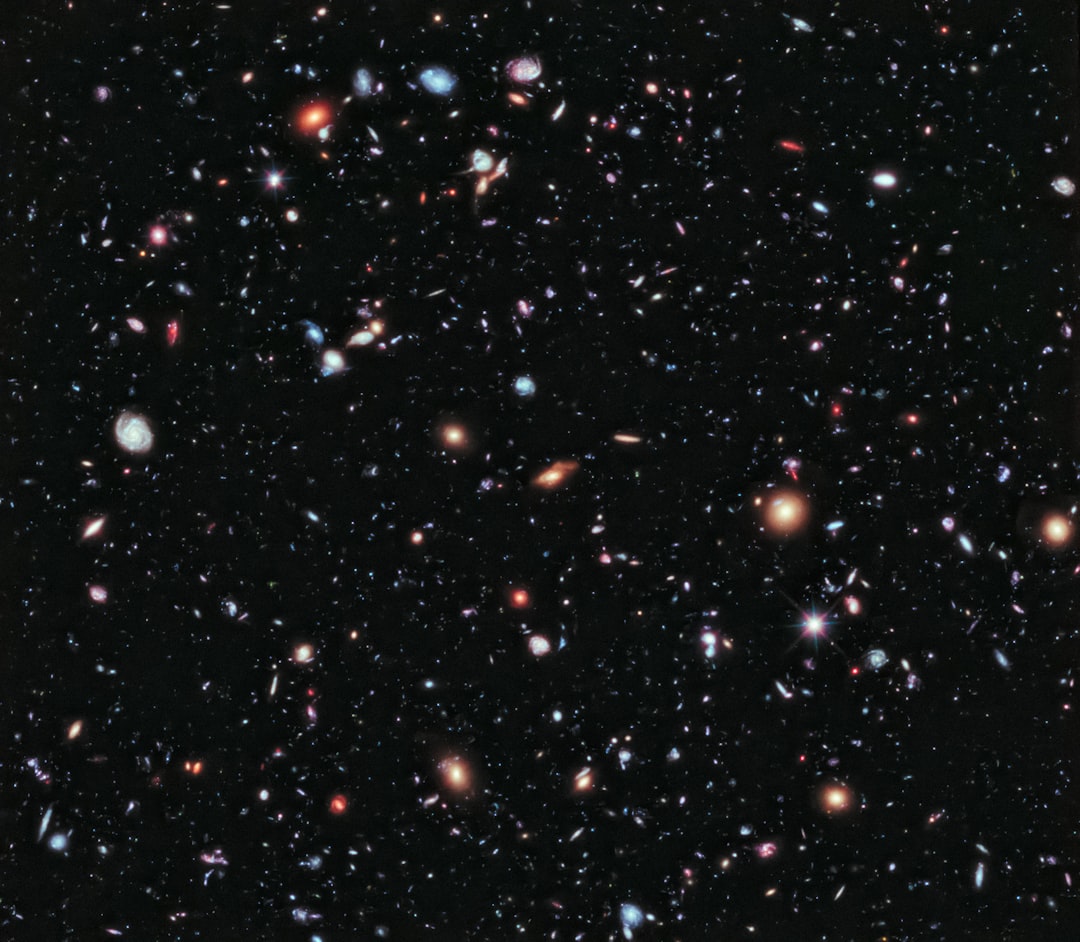
The JWST has revealed a class of small, distant galaxies in the very early universe known as little red dots (LRDs). These galaxies are near the limits of the telescope's observational power, and their true nature has been a mystery. One leading theory suggests that LRDs are primordial galaxies with active galactic nuclei (AGN) and supermassive black holes. However, this idea conflicts with current theories about the universe, as finding such massive black holes so soon after the Big Bang is unexpected.
A Unique Discovery: CANUCS-LRD-z8.6
The discovery of CANUCS-LRD-z8.6 provides compelling evidence for the existence of actively growing supermassive black holes in the early universe. Lead author Roberta Tripodi and her team used the JWST's NIRSpec instrument to analyze the galaxy's spectra, revealing key features that strongly suggest the presence of an accreting black hole:
- Broad line emissions: Produced by material orbiting very close to the black hole at extremely high velocities
- High-ionization lines: Originate from atoms that have had electrons stripped away by intense radiation in extreme conditions near the black hole
"This discovery is truly remarkable. We've observed a galaxy from less than 600 million years after the Big Bang, and not only is it hosting a supermassive black hole, but the black hole is growing rapidly - far faster than we would expect in such a galaxy at this early time," said lead author Roberta Tripodi.
A Model to Explain the Observations
To account for the unique properties of CANUCS-LRD-z8.6, the researchers developed a physical model of the galaxy. In this hypothesized model:
- The line of sight to the AGN is not heavily obscured by dust
- The majority of the stellar light comes from stars still embedded in the gas clouds they formed in, leading to high obscuration
- The galaxy is highly compact and undergoing an episode of star formation with a high dust covering fraction
- A highly energetic AGN has cleared a sight-line in our direction
This model suggests that CANUCS-LRD-z8.6 may be more evolved than other LRDs and could be an evolutionary link between early massive black holes and the brightest quasars observed at lower redshifts.
Implications and Future Research
The discovery of CANUCS-LRD-z8.6 raises important questions about the processes that allowed such massive black holes to emerge so early in the universe's history. It provides essential constraints for simulations and theoretical models of black hole and galaxy formation.
The research team plans to conduct further observations of CANUCS-LRD-z8.6 using both the JWST and the Atacama Large Millimetre/submillimetre Array (ALMA). ALMA's ability to detect cold gas in the system will help refine and broaden our understanding of this fascinating ancient galaxy.
"As we continue to analyse the data, we hope to find more galaxies like CANUCS-LRD-z8.6, which could provide us with even greater insights into the origins of black holes and galaxies," said Prof. Maruša Bradač, leader of the group at the University of Ljubljana.
This groundbreaking discovery is just the beginning of a new era in our understanding of the early universe. As more powerful telescopes like the JWST continue to probe the cosmos, we can expect to uncover even more surprises that will reshape our theories of cosmic evolution.