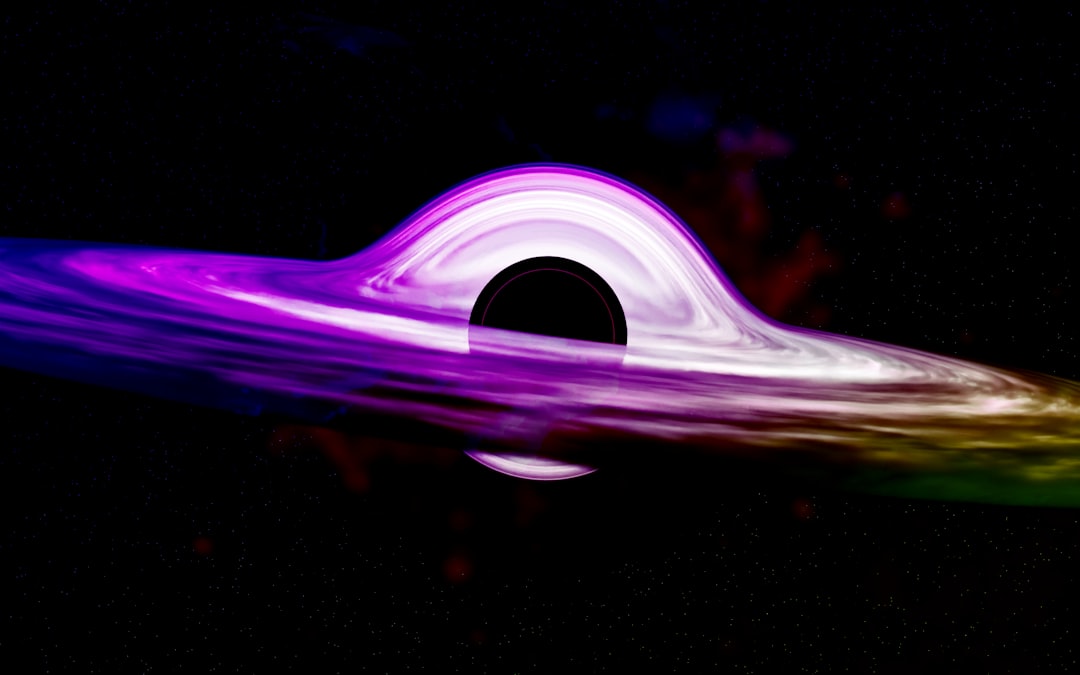
In a groundbreaking achievement that builds upon their historic 2019 breakthrough, the Event Horizon Telescope (EHT) collaboration has unveiled remarkable new images that reveal the intricate structure of the massive jet emanating from the supermassive black hole at the heart of galaxy Messier 87. This international team of over 300 scientists has successfully traced the origins of one of the universe's most powerful cosmic phenomena, providing unprecedented insights into how supermassive black holes generate and launch relativistic jets that extend thousands of light-years into space.
The new observations, published in the prestigious journal Astronomy & Astrophysics, represent a crucial step forward in understanding the mechanics of black hole jet formation. By employing advanced radio interferometry techniques and analyzing data collected in 2021, researchers have finally pinpointed the jet's launch point—a discovery that has eluded astronomers for decades despite extensive study of this extraordinary cosmic engine.
Located approximately 55 million light-years from Earth in the constellation Virgo, M87* stands as one of the most massive black holes ever detected, with a mass exceeding 6.5 billion times that of our Sun and a diameter spanning an astounding 25,000 astronomical units. The black hole's immense gravitational influence and rapid rotation create conditions so extreme that they accelerate charged particles to velocities approaching the speed of light, generating jets that shine brilliantly across the entire electromagnetic spectrum.
Revolutionary Imaging Techniques Unlock New Cosmic Secrets
The EHT collaboration's success stems from their sophisticated application of Very Long Baseline Interferometry (VLBI), a technique that effectively transforms multiple radio telescopes scattered across the globe into a single Earth-sized virtual observatory. This method combines electromagnetic signals from observatories separated by thousands of kilometers, achieving angular resolution far exceeding what any individual telescope could accomplish alone.
What makes these latest observations particularly significant is the team's strategic use of intermediate baselines—telescope separations falling between a few hundred and several thousand kilometers. While the longest baselines resolved the black hole's shadow and immediate surroundings with unprecedented clarity, and shorter baselines captured the extended jet structure, these intermediate measurements proved crucial for connecting the two regions and revealing the jet's origin point.
Dr. Saurabh, a researcher at the Max Planck Institute for Radio Astronomy who led the study, explained the breakthrough in a press release:
"This study represents an early step toward connecting theoretical ideas about jet launching with direct observations. Identifying where the jet may originate and how it connects to the black hole's shadow adds a key piece to the puzzle and points toward a better understanding of how the central engine operates."
Mapping the Jet's Birthplace Near the Event Horizon
The research team's analysis revealed that the luminous ring of superheated plasma surrounding M87*, famously captured in the 2019 image, accounts for only part of the radio emissions detected by the EHT network. By meticulously comparing radio intensity measurements across different spatial scales and applying sophisticated computational models, the scientists identified an additional compact emission region that had previously gone undetected.
This newly discovered region lies approximately 0.09 light-years from the black hole's center—remarkably close on cosmic scales yet far enough to provide critical insights into the jet formation process. The location appears to coincide precisely with the base of the relativistic jet, suggesting this is where the black hole's powerful magnetic fields and rotation work in concert to accelerate matter to near-light speeds.
The observations also revealed dynamic polarization patterns in the jet's structure, indicating complex magnetic field configurations that play a fundamental role in channeling and accelerating the outflowing material. These magnetic field lines, twisted and amplified by the black hole's rotation through a process known as the Blandford-Znajek mechanism, act like cosmic particle accelerators on a scale that dwarfs anything achievable in terrestrial laboratories.
Evolution of Observational Capabilities
The path to this discovery required years of technological advancement and observational refinement. Earlier EHT observations conducted in 2017 and 2018, while groundbreaking in their own right, lacked the intermediate baseline coverage necessary to detect the jet's base structure. The addition of new telescopes to the array and improvements in data processing algorithms provided the enhanced resolution required for these latest findings.
Hendrik Müller from the National Radio Astronomy Observatory emphasized the cumulative nature of this achievement:
"We have observed the inner part of the jet of M87 with global VLBI experiments for many years, with ever-increasing resolution, and finally managed to resolve the black hole shadow in 2019. It is amazing to see that we are gradually moving towards combining these breakthrough observations across multiple frequencies and complete the picture of the jet launching region."
Scientific Implications and Theoretical Frameworks
These observations provide crucial empirical evidence for testing competing theories about black hole jet formation mechanisms. For decades, astrophysicists have proposed various models to explain how supermassive black holes generate these extraordinary outflows, but direct observational confirmation has remained elusive due to the extreme scales and conditions involved.
The key findings from this research include:
- Jet Launch Point Identification: The discovery of a compact emission region 0.09 light-years from M87* provides the first direct evidence of where the jet originates, supporting models that predict jet formation occurs close to but outside the event horizon
- Multi-Scale Emission Structure: The detection of radio emissions across different spatial scales demonstrates that the jet formation region has a complex, stratified structure rather than a simple point source
- Dynamic Magnetic Field Configurations: Observed polarization patterns reveal how magnetic fields thread through the accretion disk and are amplified to power the jet acceleration process
- Connection to Black Hole Shadow: The new observations successfully link the photon ring visible in the 2019 image to the base of the relativistic jet, providing a complete picture of the near-horizon environment
These findings align remarkably well with general relativistic magnetohydrodynamic (GRMHD) simulations that model plasma behavior in the extreme gravitational and magnetic field environment near a rotating black hole. The agreement between observation and theory represents a triumph for our understanding of physics under the most extreme conditions in the universe.
The Physics of Relativistic Jets
Understanding how M87* generates its spectacular jet requires appreciating the extraordinary physics at play near a supermassive black hole. As matter spirals inward through the accretion disk, gravitational energy converts to heat, raising temperatures to billions of degrees. At these extreme temperatures, matter exists as a plasma of free electrons and ions, which interact strongly with magnetic fields threading through the disk.
The black hole's rapid rotation—M87* completes a full rotation in mere hours despite its enormous size—drags the surrounding spacetime along with it, a phenomenon predicted by Einstein's general relativity known as frame-dragging or the Lense-Thirring effect. This rotation also winds up magnetic field lines like a cosmic dynamo, creating powerful magnetic pressure that can overcome gravity and launch material perpendicular to the accretion disk.
The result is a collimated beam of particles and radiation that maintains its narrow structure across thousands of light-years, visible to telescopes operating across the electromagnetic spectrum from radio waves to gamma rays. The M87 jet extends at least 3,000 light-years from its source, making it one of the most prominent features visible in deep-sky images of this region.
Comparative Black Hole Studies
While M87* represents the first black hole to have its shadow directly imaged, it's not the only target of EHT observations. The collaboration also captured images of Sagittarius A*, the supermassive black hole at the center of our own Milky Way galaxy, released in 2022. Comparing these two systems provides valuable insights into how black hole properties influence jet formation and behavior.
M87* is approximately 1,500 times more massive than Sgr A* and exhibits a much more prominent jet structure, suggesting that black hole mass, spin rate, and accretion rate all play crucial roles in determining whether and how a black hole generates relativistic outflows. These comparative studies help astronomers develop a more comprehensive understanding of active galactic nuclei and their role in galaxy evolution.
Future Observations and Technological Advances
The EHT collaboration continues to expand its capabilities with each observing campaign. Sebastiano von Fellenberg, formerly at MPIfR and currently at the Canadian Institute for Theoretical Astrophysics, highlighted upcoming enhancements that promise even sharper views of M87*'s jet launching region:
"Newly observed data—now being correlated and calibrated with support from MPIfR—will soon add back the Large Millimetre Telescope in Mexico. This will bring an even sharper view of the jet‑launching region within reach."
The addition of the Large Millimetre Telescope (LMT) in Mexico, along with potential future array members, will provide crucial additional baselines that can further constrain the jet's size, shape, and structure. These improvements will enable the team not merely to map the jet's properties but to create time-resolved movies showing how the jet structure evolves over hours and days.
Future observing campaigns planned for the coming years aim to achieve several ambitious goals:
- Multi-Frequency Imaging: Simultaneous observations at multiple wavelengths will reveal how different physical processes contribute to jet emission at various distances from the black hole
- Time-Domain Studies: Repeated observations will capture dynamic changes in the jet structure, providing insights into variability and instabilities in the accretion flow
- Polarimetric Mapping: Detailed polarization measurements will trace magnetic field geometry throughout the jet launching region with unprecedented precision
- Extended Array Coverage: Additional telescopes in Africa and Asia will fill gaps in the current array configuration, improving image quality and resolution
Broader Implications for Astrophysics
The EHT's observations of M87* extend far beyond simply imaging a single black hole. These studies provide a unique laboratory for testing general relativity in the strong-field regime, where gravitational effects become so extreme that they dramatically warp spacetime itself. The agreement between observations and theoretical predictions confirms that Einstein's century-old theory continues to accurately describe nature even under the most extreme conditions we can observe.
Furthermore, understanding jet formation mechanisms has profound implications for our comprehension of galaxy evolution across cosmic time. Relativistic jets from supermassive black holes inject enormous amounts of energy into their surrounding galaxies, heating gas that might otherwise cool and form stars. This "feedback" process plays a crucial role in regulating star formation and may explain why the most massive galaxies in the universe stopped forming stars billions of years ago.
The techniques pioneered by the EHT collaboration also demonstrate the power of international scientific cooperation. The project brings together institutions from across the globe, pooling resources and expertise to achieve observations impossible for any single nation or organization. This model of collaboration offers a template for tackling other grand challenges in astronomy and physics.
As we stand on the threshold of a new era in black hole astronomy, the EHT's latest findings remind us that each answer generates new questions. How do magnetic fields achieve the extraordinary configurations required to launch jets? What determines whether a black hole produces a powerful jet like M87* or remains relatively quiet? How do jets interact with and influence their host galaxies over billions of years?
The coming years promise exciting discoveries as the EHT continues to push the boundaries of observational astronomy. With improved technology, expanded arrays, and innovative analysis techniques, we can anticipate increasingly detailed portraits of these cosmic engines that shape the universe on the grandest scales. The journey from the first black hole shadow image to mapping jet origins represents just the beginning of a new chapter in humanity's quest to understand the most extreme objects in the cosmos.