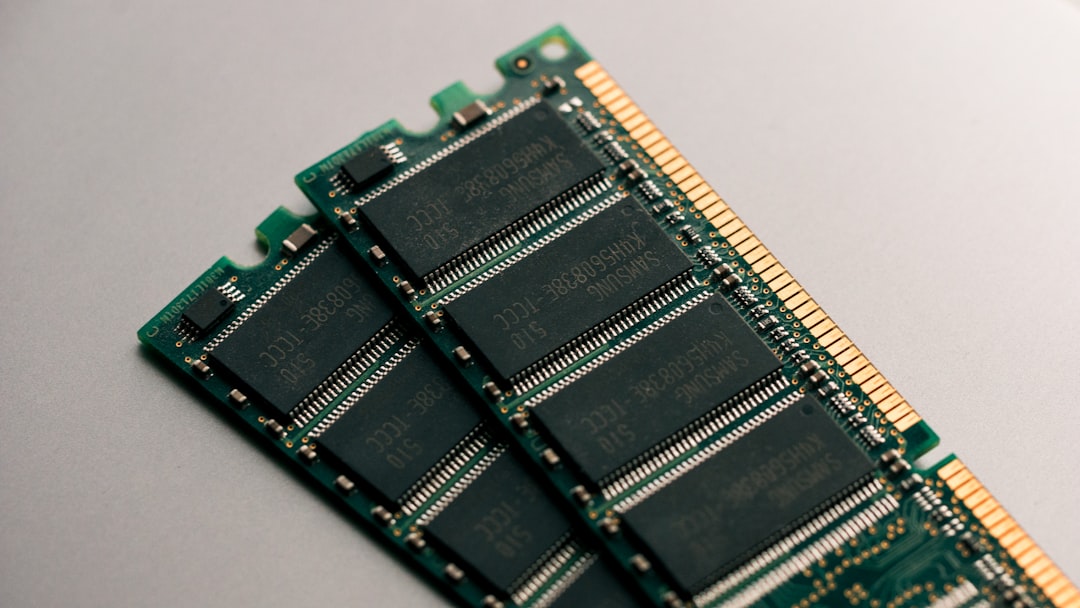
When a spacecraft ventures hundreds of millions of kilometers into the depths of our solar system, there's no IT department standing by to recover corrupted files. Every byte of data transmitted back to Earth represents years of planning, billions of dollars in investment, and humanity's insatiable curiosity about the cosmos. Yet the very technology we rely on to store this precious information—the same NAND flash memory that powers our smartphones and laptops—becomes increasingly vulnerable the moment it leaves Earth's protective magnetic bubble. Now, researchers at the Georgia Institute of Technology have developed a revolutionary approach that could fundamentally transform how we preserve data in the hostile radiation environment of deep space.
The challenge isn't merely theoretical. Consider NASA's Juno spacecraft, currently orbiting Jupiter in one of the most radiation-intense environments in our solar system, or the upcoming Europa Clipper mission that will brave Jupiter's punishing radiation belts to study the icy moon's potential for harboring life. These missions generate enormous volumes of scientific data—high-resolution images, spectroscopic measurements, magnetic field readings—all of which must be stored reliably before transmission to Earth. When your data storage system fails 640 million kilometers from home, with communication delays stretching to 45 minutes one-way, the entire mission hangs in the balance.
The Radiation Problem Plaguing Space Exploration
Traditional flash memory technology operates by trapping electrical charges in tiny isolated cells, with each cell representing a bit of information. On Earth, surrounded by our planet's protective magnetosphere and thick atmosphere, this system works flawlessly. But venture beyond low Earth orbit, and spacecraft encounter a relentless barrage of high-energy particles—cosmic rays, solar wind protons, and trapped radiation belt electrons—that can penetrate shielding and wreak havoc on electronic systems.
These energetic particles don't just damage memory chips through direct impacts. They create cascading effects within the semiconductor material itself, generating electron-hole pairs that can discharge stored bits, flip data values, and gradually degrade the insulating layers that keep information intact. According to research published by IEEE's radiation effects community, conventional NAND flash memory begins experiencing significant data corruption at radiation doses around 30,000 rads—a threshold that deep space missions can exceed within just a few years of operation.
The problem intensifies as missions become more ambitious. The Voyager spacecraft, launched in 1977, carried relatively simple data storage systems because they operated in an era when data collection rates were modest. Modern missions like the James Webb Space Telescope or planned missions to the outer solar system generate terabytes of information, requiring high-density storage solutions that can maintain data integrity for decades while exposed to cumulative radiation doses that would destroy conventional electronics.
Ferroelectric Memory: A Fundamentally Different Approach
The Georgia Tech breakthrough centers on a property of matter called ferroelectricity—a phenomenon where certain crystalline materials develop a spontaneous, stable electric polarization that can be reversed by applying an external electric field. Unlike conventional flash memory, which stores data as trapped charges that can be dislodged by radiation, ferroelectric memory encodes information in the physical orientation of electric dipoles within the material's crystal structure itself.
Think of it this way: traditional memory is like trying to hold water in a leaky bucket, where radiation gradually punches holes that let the charge drain away. Ferroelectric memory, by contrast, is like encoding information in the alignment of compass needles—you can shake the system, bombard it with particles, and the fundamental orientation remains stable because it's locked into the material's atomic structure.
"The key insight is that ferroelectric polarization is an intrinsic property of the material's crystal structure, not just trapped charges sitting in potential wells. This makes it inherently more resistant to radiation-induced disruption," explains Dr. Asif Khan, the lead researcher on the Georgia Tech team.
The research team fabricated their ferroelectric NAND flash memory chips using hafnium oxide-based ferroelectric materials, which can be integrated into existing semiconductor manufacturing processes. This compatibility with current fabrication technology is crucial—it means the innovation doesn't require entirely new manufacturing facilities or exotic materials that would be prohibitively expensive for space applications.
Unprecedented Radiation Tolerance Demonstrated
To validate their approach, the Georgia Tech researchers collaborated with scientists at Pennsylvania State University who specialize in radiation effects testing. The ferroelectric memory chips were subjected to intense gamma radiation and heavy ion bombardment designed to simulate decades of deep space exposure compressed into accelerated testing protocols.
The results exceeded expectations. The ferroelectric NAND chips maintained data integrity at radiation doses up to one million rads—equivalent to approximately 100 million chest X-rays, or the cumulative radiation exposure a spacecraft might encounter during a 15-20 year mission to the outer solar system. This represents a 30-fold improvement over conventional flash memory technology, which typically begins experiencing catastrophic failures around 30,000-40,000 rads.
To put these numbers in perspective:
- Low Earth Orbit missions: Experience approximately 1,000-10,000 rads over a typical 5-10 year mission lifetime
- Interplanetary cruise: Spacecraft traveling through deep space encounter 100,000-300,000 rads during multi-year journeys
- Jupiter orbital missions: Face the most extreme environment, with radiation doses reaching 500,000 to several million rads due to Jupiter's intense magnetosphere
- Ferroelectric NAND tolerance: Demonstrated survival at 1,000,000+ rads, providing substantial safety margins even for the most challenging missions
Implications for Autonomous Deep Space Exploration
The timing of this breakthrough couldn't be more critical. Space agencies worldwide are transitioning toward increasingly autonomous spacecraft that must make complex decisions without waiting for instructions from Earth. The European Space Agency's JUICE mission to Jupiter's moons and NASA's Dragonfly mission to Saturn's moon Titan both incorporate sophisticated artificial intelligence systems that process vast amounts of sensor data in real-time, identifying scientifically interesting targets and adapting observation strategies on the fly.
These AI systems require reliable, high-capacity memory to function. Machine learning models, neural networks for image recognition, and decision-making algorithms all depend on intact data storage. A single bit flip in a critical algorithm parameter could cause an autonomous spacecraft to misidentify a scientifically valuable feature or, worse, make a navigation error that jeopardizes the entire mission.
Moreover, as missions venture farther from Earth—to the outer planets, the Kuiper Belt, and eventually to interstellar space—the communication delays become so severe that real-time human oversight becomes impossible. A spacecraft at Neptune, 4.5 billion kilometers from Earth, experiences an eight-hour round-trip light delay. In such scenarios, the spacecraft must be its own mission control, and that requires memory systems that simply cannot fail.
Manufacturing Scalability and Future Development
One of the most promising aspects of the Georgia Tech innovation is its compatibility with existing semiconductor manufacturing infrastructure. The hafnium oxide ferroelectric materials used in the memory chips can be deposited and patterned using modified versions of current fabrication processes, rather than requiring entirely new production facilities.
This manufacturing compatibility addresses a critical bottleneck in space technology development. Historically, radiation-hardened electronics have been extraordinarily expensive because they required specialized fabrication processes, limited production volumes, and extensive qualification testing. By leveraging existing manufacturing capabilities, ferroelectric NAND could potentially achieve the cost-effectiveness needed for widespread adoption across multiple missions.
The research team is now working on several fronts to advance the technology toward flight readiness:
- Endurance testing: Verifying that the memory can withstand millions of write-erase cycles while maintaining radiation tolerance
- Temperature extremes: Ensuring functionality across the wide temperature ranges encountered in space, from -180°C in shadowed craters to +120°C in direct sunlight
- Scaling density: Increasing storage capacity to multi-terabyte levels required for next-generation science missions
- System integration: Developing complete data storage systems with error correction, wear leveling, and redundancy features
A New Era of Data-Intensive Space Science
The development of radiation-tolerant ferroelectric memory represents more than just an incremental improvement in space technology—it potentially enables entirely new classes of missions that were previously impractical. Consider a swarm of small satellites exploring the asteroid belt, each carrying high-resolution cameras and spectrometers generating gigabytes of data daily. Or imagine a long-duration mission to study the ice giants Uranus and Neptune, spending years in orbit collecting comprehensive datasets about these poorly understood worlds.
These ambitious scenarios require not just radiation tolerance, but also the high storage densities that NAND flash technology provides. Previous radiation-hardened memory solutions, while robust, typically offered far lower storage capacities—megabytes or at most a few gigabytes—because they relied on older, less dense memory architectures. Ferroelectric NAND bridges this gap, potentially offering both the capacity and the resilience needed for the next generation of space exploration.
As humanity sets its sights on establishing a sustained presence beyond Earth—lunar bases, Mars settlements, mining operations in the asteroid belt—reliable data storage becomes infrastructure, not just mission equipment. The difference between data that survives and data that's lost to radiation could ultimately be the difference between success and silence, between understanding our cosmic neighborhood and remaining forever ignorant of its secrets.
The Georgia Tech team's work reminds us that sometimes the most profound advances come not from entirely new technologies, but from fundamentally rethinking how we use the materials and principles already at our disposal. In the unforgiving environment of deep space, where there are no second chances and no repair crews, that kind of innovation isn't just clever engineering—it's absolutely essential.