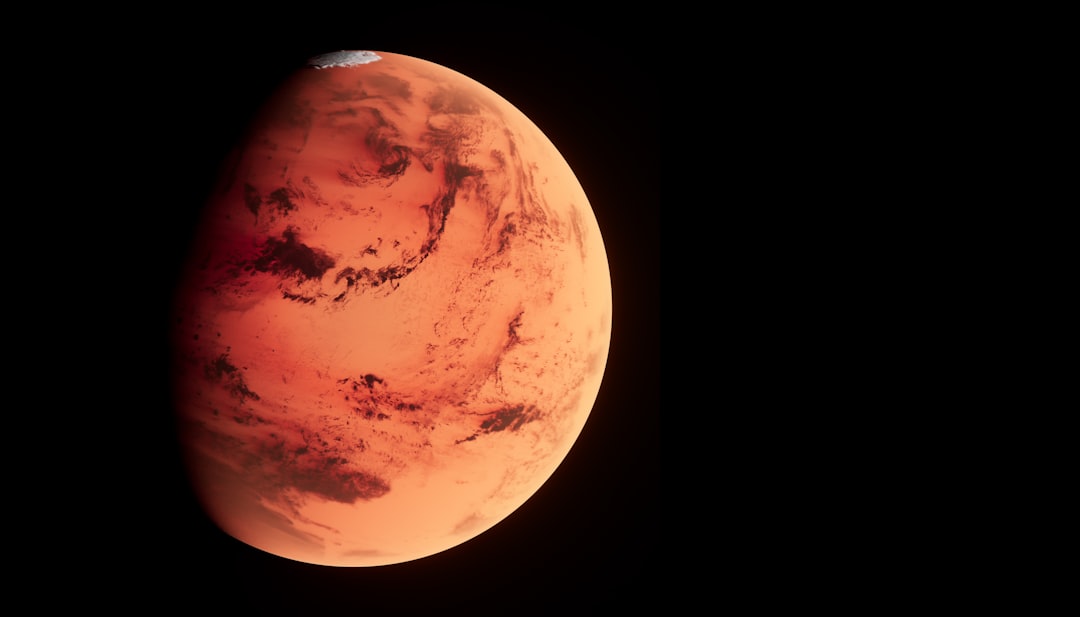
Mars has long captivated scientists with its ancient volcanic landscapes, but new research is revealing that the Red Planet's geological story is far more sophisticated than previously imagined. A groundbreaking study published in the journal Geology demonstrates that Martian volcanic systems underwent complex, multi-stage evolution, challenging our understanding of how volcanism operated on our neighboring world. These findings suggest that Mars maintained an active and dynamic subsurface for far longer than many researchers expected, fundamentally reshaping our view of the planet's geological timeline.
The discovery centers on volcanic formations located south of Pavonis Mons, one of the towering shield volcanoes in Mars' legendary Tharsis region. Using cutting-edge orbital reconnaissance and sophisticated spectroscopic analysis, an international team of planetary scientists has pieced together a remarkably detailed narrative of volcanic activity that spans millions of years. What emerges is a portrait of a world where subsurface magma chambers evolved, transformed, and fed multiple eruption styles—much like the complex plumbing systems beneath Earth's most dynamic volcanic regions.
Decoding Mars' Volcanic Architecture From Orbit
Understanding volcanic processes on another planet presents extraordinary challenges. Unlike terrestrial volcanoes where geologists can collect samples, deploy seismometers, and conduct field surveys, Martian volcanism must be studied entirely through remote sensing techniques. The research team leveraged high-resolution imagery from NASA's Mars Reconnaissance Orbiter and thermal infrared data from previous missions to create a comprehensive geological map of the volcanic system.
The volcanic complex under investigation lies in one of Mars' most geologically significant regions. The Tharsis volcanic province hosts some of the largest volcanoes in the entire solar system, including Olympus Mons, which towers approximately 21 kilometers above the surrounding plains—nearly three times the height of Mount Everest. Pavonis Mons itself rises about 14 kilometers, sitting at the center of the Tharsis Montes chain alongside Arsia Mons and Ascraeus Mons. These massive structures formed over hundreds of millions of years, but the smaller volcanic systems surrounding them have received less attention until now.
What makes this particular volcanic field so revealing is its relative youth in Martian terms. While the giant shields of Tharsis began forming billions of years ago, the features studied in this research represent some of Mars' most recent volcanic activity, potentially occurring within the last few hundred million years—practically yesterday in geological time. This temporal context makes them invaluable for understanding the planet's late-stage volcanic processes.
A Tale of Two Eruption Styles
The research revealed something unexpected: this volcanic system didn't follow a simple, uniform pattern of activity. Instead, it exhibited distinct phases of eruption, each with its own characteristic style and surface expression. Early in the system's history, volcanic activity manifested as fissure eruptions—dramatic events where lava fountained from elongated cracks in the Martian crust, sometimes extending for kilometers across the landscape.
These fissure eruptions would have been spectacular events, with curtains of molten rock spraying into Mars' thin atmosphere before flowing across the surface in broad sheets. On Earth, similar eruptions occur in places like Iceland and Hawaii, where tectonic forces or deep magma pressure create linear vents. The Hawaiian Volcano Observatory has documented numerous fissure eruptions that provide terrestrial analogues for understanding the Martian features.
Later in the volcanic system's evolution, the eruption style shifted dramatically. Instead of long fissures, lava began erupting from concentrated point sources, building up distinctive cone-shaped vents. These features, known as scoria cones or cinder cones, form when gas-rich magma erupts explosively, fragmenting into pyroclastic material that accumulates around the vent. The transition from fissure to point-source eruptions suggests fundamental changes in how magma was being delivered from depth.
The volcanic system's evolution from fissure eruptions to centralized vents reveals a sophisticated underground plumbing network that remained active and dynamic for millions of years, challenging assumptions about Mars' geological decline.
The Mineral Detective Work: Reading Mars' Chemical Signatures
Perhaps the most significant aspect of this research lies in the mineralogical analysis of the different lava flows. Using infrared spectroscopy, scientists can identify specific minerals present in Martian rocks based on how they absorb and reflect different wavelengths of light. Each mineral has a unique spectral signature—essentially a chemical fingerprint—that can be detected from orbit.
The team discovered that each phase of volcanic activity left behind distinctly different mineral assemblages. These variations aren't random; they tell a coherent story about what was happening deep beneath the Martian surface. The chemical composition of magma changes based on several factors: the depth from which it originated, how long it spent stored in underground chambers, what temperature it reached, and whether it mixed with other magma batches or interacted with surrounding rock.
Think of a magma chamber as a complex chemical reactor. As magma sits underground, denser minerals crystallize and sink, while lighter components rise. The magma can also partially melt surrounding rock, incorporating new chemical components. If fresh magma arrives from deeper sources, it can mix with older, more evolved magma. All these processes leave distinctive chemical signatures in the resulting lava flows. The research conducted by institutions like the Lunar and Planetary Institute has developed sophisticated models for interpreting these signatures.
The varying mineral compositions detected in this Martian volcanic field suggest that the magma source evolved over time. Some eruptions tapped relatively primitive magma from greater depths, while others erupted more evolved magma that had spent considerable time in shallow chambers, undergoing crystallization and chemical modification. This diversity indicates a multi-level magma plumbing system—not just a simple conduit from depth to surface, but a network of interconnected chambers and pathways.
Implications for Martian Geology and Planetary Evolution
These findings carry profound implications for our understanding of Mars' geological history and internal structure. For decades, the prevailing narrative suggested that Mars experienced robust volcanic activity early in its history when internal heat was abundant, followed by a gradual decline as the planet cooled and its interior solidified. While this broad picture remains valid, the new research reveals that late-stage Martian volcanism was far more sophisticated than a simple winding down of activity.
The existence of evolving magma systems during Mars' recent geological past indicates that the planet's interior remained thermally and chemically active much longer than some models predicted. This has implications for understanding Mars' thermal evolution, the longevity of its magnetic field (which ceased billions of years ago), and even the potential for subsurface environments that might have supported microbial life.
Key insights from this research include:
- Complex magma storage systems: Even during recent volcanic periods, Mars maintained multi-level magma chambers capable of storing and evolving magma over extended timeframes, similar to terrestrial volcanic systems.
- Dynamic subsurface processes: The variation in eruption styles and magma compositions demonstrates that Mars' subsurface remained geologically active, with changing conditions affecting how and where magma reached the surface.
- Extended volcanic timeline: The sophistication of these young volcanic systems suggests that Mars' volcanic history didn't simply fade away but continued as a dynamic process well into relatively recent geological time.
- Planetary heat budget: Maintaining active magma systems requires significant internal heat, implying that Mars retained more thermal energy longer than some thermal evolution models suggested.
Windows Into Planetary Interiors
One of the most valuable aspects of studying volcanic systems—whether on Earth, Mars, or any other world—is that they provide direct evidence of subsurface processes. The surface expressions of volcanism are literally windows into what's happening kilometers below, in regions we can never directly observe on Mars with current technology.
On Earth, volcanologists combine surface observations with seismic data, drill core samples, and direct measurements of erupting volcanoes to build comprehensive models of magmatic systems. Mars presents a different challenge: we must extract maximum information from surface features alone. This makes detailed studies of volcanic morphology and mineralogy crucial for understanding the planet's interior structure and evolution.
The research methodology employed in this study represents the state-of-the-art in planetary volcanology. By integrating high-resolution imagery that reveals subtle topographic features with spectroscopic data that identifies mineral compositions, scientists can reconstruct eruption sequences, estimate magma properties, and infer subsurface architecture. Missions like the Mars 2020 Perseverance rover continue this work at ground level, providing even more detailed analysis of Martian rocks and their formation histories.
Future Directions in Martian Volcanic Research
This discovery opens numerous avenues for future investigation. One pressing question concerns the absolute ages of these volcanic features. While scientists can determine relative ages by examining which lava flows overlay others, establishing precise dates requires either radiometric dating of returned samples or sophisticated crater-counting techniques that correlate impact crater density with surface age.
The Mars Sample Return mission, a collaborative effort between NASA and the European Space Agency, aims to bring Martian rocks back to Earth for detailed laboratory analysis. If samples from young volcanic regions can be obtained, they would provide unprecedented insights into recent Martian magmatism, including precise eruption dates, detailed chemical compositions, and information about volatile content that's difficult to determine from orbit.
Another frontier involves searching for evidence of even more recent volcanic activity. Some researchers have proposed that Mars might experience occasional eruptions even today, though this remains controversial. Detecting active volcanism would revolutionize our understanding of the planet's current geological state and internal heat budget. The InSight lander, which operated from 2018 to 2022, deployed seismometers that detected numerous "marsquakes," some potentially associated with magmatic or volcanic processes.
Additionally, understanding Mars' volcanic evolution helps contextualize observations of other planets. Comparative planetology—examining how similar processes operate differently on various worlds—provides insights into the fundamental physics and chemistry governing planetary interiors. Venus, for instance, shows extensive volcanic features but has a very different internal structure and surface conditions than Mars. Mercury's volcanic history appears limited, while the icy moons of Jupiter and Saturn exhibit cryovolcanism involving water and other volatiles rather than silicate magma.
The Broader Context of Planetary Volcanism
This research reinforces an important principle in planetary science: geological processes rarely follow simple, linear paths. Just as Earth's volcanic systems exhibit enormous diversity—from the gentle lava flows of Hawaii to the explosive eruptions of Mount St. Helens—Mars demonstrates that volcanic complexity isn't unique to our planet. The Red Planet may be smaller, colder, and lack plate tectonics, but it has produced volcanic systems with their own sophisticated behaviors and evolutionary patterns.
The study also highlights how much we've learned about Mars in recent decades through orbital reconnaissance. The fleet of spacecraft currently studying Mars—including NASA's Mars Reconnaissance Orbiter, Mars Odyssey, and MAVEN, along with ESA's Mars Express and the joint ExoMars Trace Gas Orbiter—provides continuous, high-resolution coverage of the planet's surface and atmosphere. This sustained observation capability allows scientists to conduct detailed studies that would have been impossible with earlier, limited missions.
As we look toward future human exploration of Mars, understanding the planet's volcanic history becomes practically important as well. Volcanic regions often harbor valuable resources, including water ice trapped in porous volcanic rocks, minerals that could support in-situ resource utilization, and potentially even subsurface environments protected from Mars' harsh surface radiation. The complex volcanic systems revealed by this research might someday serve as targets for human scientific expeditions or even habitation sites.
Mars continues to surprise us, revealing layer upon layer of geological sophistication that challenges our assumptions about how small, rocky planets evolve over billions of years. These young volcanic systems, with their evolved magmas and changing eruption styles, remind us that Mars wasn't simply a once-active world that fell silent. Instead, it remained a dynamic, geologically vibrant planet far longer than we once believed—and may still harbor surprises waiting to be discovered in its mysterious depths.