In a groundbreaking discovery that challenges our fundamental understanding of planetary systems, astronomers have documented an extraordinary celestial phenomenon occurring 371 light-years from Earth. The TOI-201 system is exhibiting something rarely observed in exoplanetary science: planets whose orbital alignments are shifting so rapidly that scientists can witness the evolution in real-time—a process that typically requires millions of years to observe. This remarkable finding, published in Science Advances, represents a watershed moment in our understanding of how planetary systems can behave far differently from our own orderly solar system.
An international collaboration of more than 50 researchers has spent years piecing together this cosmic puzzle, utilizing data from telescopes spanning the globe—from the frozen Antarctic plateau to observatories in the Northern Hemisphere. Their work reveals that the three planets orbiting the F-type star TOI-201 are engaged in a gravitational dance so complex that their transits across their host star are becoming increasingly unpredictable. Even more remarkably, within approximately two centuries, these planets will cease to transit their star from our vantage point altogether, remaining invisible to transit detection methods for roughly 10,000 years before resuming their observable crossings.
This discovery fundamentally reshapes our understanding of planetary system dynamics and suggests that the neat, orderly arrangement of our own solar system may be more the exception than the rule. With over 6,100 confirmed exoplanets discovered across more than 4,500 planetary systems, astronomers are increasingly recognizing that the universe's architectural diversity far exceeds early predictions based on our solar system's configuration.
The Unique Architecture of the TOI-201 System
The TOI-201 system presents a fascinating case study in planetary diversity and gravitational complexity. At its center lies an F-type main sequence star, a stellar class that is both larger and significantly hotter than our Sun. According to NASA's exoplanet research, F-type stars typically have surface temperatures between 6,000 and 7,500 Kelvin, compared to our Sun's 5,778 Kelvin, making them particularly interesting targets for exoplanet studies.
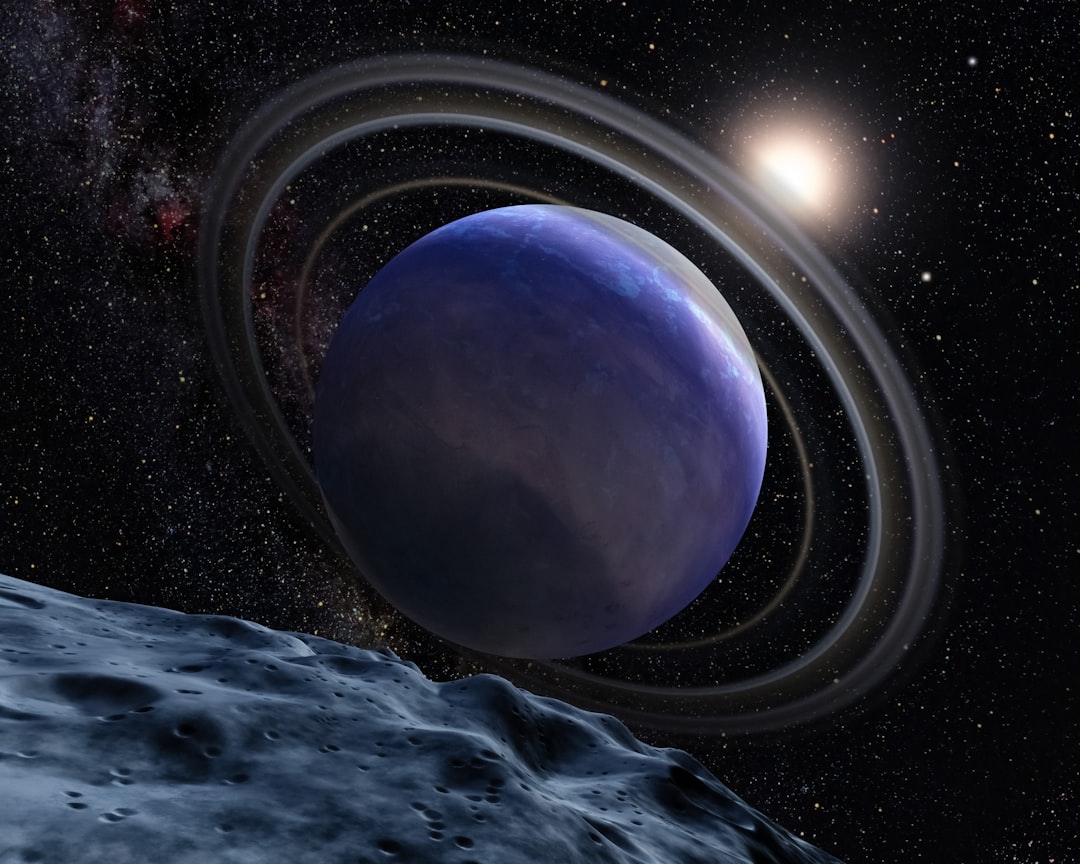
The system hosts three dramatically different worlds. The innermost planet is classified as a super-Earth, completing its orbit in merely 5.8 days—a blistering pace that places it extremely close to its host star. The middle planet, designated TOI-201 b, is a gas giant with an orbital period of approximately 53 days. However, the true disruptor of this system is the outermost planet, TOI-201 c, a massive gas giant that takes roughly 2,900 days—nearly 8 years—to complete a single orbit around its star.
What makes TOI-201 c particularly remarkable is its highly elliptical orbit, resembling the elongated paths traced by comets in our solar system rather than the nearly circular orbits of our planets. This eccentric trajectory means that TOI-201 c alternates between approaching relatively close to its star and swinging far out into the system's outer reaches. This gravitational irregularity creates a cascading effect throughout the entire planetary system, fundamentally altering the orbital characteristics of its inner planetary siblings.
Revolutionary Observational Techniques and Antarctic Astronomy
The detection and characterization of the TOI-201 system's unusual behavior required an innovative observational approach combining data from multiple facilities worldwide. A crucial component of this research came from the ASTEP (Antarctic Search for Transiting ExoPlanets) facility, located at the Concordia Research Station on Antarctica's polar plateau. This unique location offers astronomers an extraordinary advantage: continuous darkness lasting between three to four months during the Antarctic winter, from March through September.
This extended observational window proved essential for tracking the subtle variations in the planets' transit timing. As explained by researchers at the European Southern Observatory, continuous monitoring is critical for detecting the minute changes in orbital behavior that characterize dynamically evolving systems like TOI-201. Traditional observatories in temperate regions face interruptions from daylight and weather patterns, making it challenging to maintain the consistent, long-duration observations necessary for this type of research.
The research team employed transit timing variation (TTV) analysis, a sophisticated technique that measures the precise moments when planets cross in front of their host star. By comparing expected transit times with actual observations, astronomers can detect gravitational interactions between planets. In the case of TOI-201, these variations weren't subtle—they were dramatic enough to puzzle the entire research team.
"Usually, planets are like metronomes with each transit in front of the star happening exactly one orbital period after another. However, we were following TOI-201b, and suddenly the planet started transiting about half an hour late. This sudden jump was very surprising, and we reported our observations. Other astronomers around the globe noticed intriguing signals too, and by working together, the team could start to understand this system," explained Dr. Amaury Triaud, Professor of Exoplanetology at the University of Birmingham and co-author of the study.
The Gravitational Chaos: Understanding Orbital Precession
The phenomenon observed in the TOI-201 system is known as orbital precession—a gradual rotation of a planet's orbital plane over time. While precession occurs in our own solar system (Mercury's orbit precesses by about 43 arcseconds per century, a fact that helped confirm Einstein's theory of general relativity), the rate observed in TOI-201 is extraordinarily rapid by astronomical standards.
The mechanism driving this dramatic behavior is the gravitational influence of the massive outer planet, TOI-201 c. When this gas giant swings closer to its star during its eccentric orbit, its gravitational perturbations exert significant force on the inner planets, particularly TOI-201 b. This interaction causes the orbital planes of the inner planets to tilt and rotate, changing the angle at which we observe them from Earth.
Through sophisticated computer modeling and numerical simulations, the research team projected the future evolution of this system. Their calculations indicate that within approximately 200 years, all three planets will have precessed to such a degree that they will no longer pass directly between their star and Earth. From our perspective, these planets will effectively vanish from transit detection methods, though they will continue orbiting their star. According to the team's models, it will take roughly 10,000 years for the orbital planes to precess back into alignment with our line of sight, at which point the planets will once again become visible through transit observations.
Real-Time Evolution: A Rare Astronomical Opportunity
Perhaps the most exciting aspect of the TOI-201 discovery is that astronomers can observe this planetary system evolution in real-time. Typically, the timescales involved in planetary dynamics span millions or billions of years—far beyond human lifespans or even the entire span of recorded history. The rapid precession rate in TOI-201 means that changes can be documented within individual research careers, offering an unprecedented opportunity to test theoretical models of planetary dynamics against observable reality.
This capability has profound implications for our understanding of planetary system stability and evolution. Researchers at NASA's Exoplanet Exploration Program note that most of our knowledge about planetary system dynamics comes from theoretical models and computer simulations. Having a system where we can directly observe and measure these changes provides invaluable validation for these models and may reveal unexpected phenomena that theory hasn't predicted.
Comparative Systems: TOI-201 in Context
The TOI-201 system is not entirely unique in exhibiting these characteristics. The research team identified several analogous systems discovered by the Kepler Space Telescope, including Kepler-419 b, Kepler-448 b, and Kepler-693 b. Each of these systems features planets whose orbits are gravitationally perturbed by massive, eccentric outer companions.
In the Kepler-419 system, astronomers have confirmed both the inner transiting planet and the massive outer perturber responsible for orbital variations. Similarly, Kepler-448 has two confirmed planets engaged in a gravitational interaction. However, Kepler-693 presents an intriguing mystery: while the inner transiting planet is confirmed, the existence of the suspected outer perturber remains unverified. The TOI-201 discovery may provide crucial insights that help astronomers confirm or refute the presence of the Kepler-693 outer planet.
These comparative cases suggest that dynamically active planetary systems may be more common than previously thought. Traditional detection methods favor finding planets in stable, well-aligned orbits because these are easiest to detect and characterize. Systems like TOI-201 may represent a significant population of planetary systems that have been systematically underrepresented in exoplanet catalogs due to observational biases.
Implications for Planetary Formation and Migration Theories
The discovery of the TOI-201 system challenges several assumptions embedded in current planetary formation theories. The classical model of planet formation, based largely on our solar system, suggests that planets form from a protoplanetary disk of gas and dust orbiting a young star. This disk is typically flat and thin, leading planets to form with orbits that lie in roughly the same plane—a configuration we observe in our own solar system where all eight planets orbit within about 7 degrees of the same plane.
However, TOI-201 demonstrates that planetary systems can evolve into highly misaligned configurations. Several mechanisms could explain this architecture:
- Planet-planet scattering: Early in a system's history, gravitational interactions between massive planets can eject some planets while sending others into eccentric, inclined orbits
- Kozai-Lidov mechanism: A distant massive companion (either planetary or stellar) can induce periodic oscillations in the eccentricity and inclination of inner planets
- Disk instability: Gravitational instabilities in the protoplanetary disk itself may lead to planet formation in multiple, misaligned planes
- Stellar companion perturbation: If the star is part of a binary or multiple star system, the gravitational influence of stellar companions can tilt planetary orbits over time
The TOI-201 system appears to be experiencing ongoing dynamical evolution driven by the massive, eccentric outer planet. This suggests that planetary systems may not reach stable configurations quickly after formation but can continue evolving over millions or even billions of years.
Future Research Directions and Technological Advances
The TOI-201 discovery opens numerous avenues for future investigation. Upcoming observational facilities, including the ESA's PLATO mission (PLAnetary Transits and Oscillations of stars), scheduled for launch in 2026, will be specifically designed to detect and characterize planets around bright stars with unprecedented precision. PLATO's capabilities will enable astronomers to identify and study additional systems exhibiting rapid orbital precession.
Ground-based facilities are also evolving to meet these challenges. The expansion of continuous monitoring programs, particularly those leveraging Antarctica's unique observational advantages, will be crucial. Dr. Triaud specifically acknowledged the critical role of the ASTEP telescope, noting that its unique capabilities during extended periods of darkness proved ideal for detecting the subtle timing variations that first alerted researchers to TOI-201's unusual behavior.
Additionally, advances in computational modeling will allow researchers to simulate increasingly complex gravitational interactions. Modern supercomputers can now run N-body simulations tracking the positions and velocities of multiple planets over millions of orbital periods, helping astronomers understand how systems like TOI-201 will evolve far into the future.
The Broader Context: Redefining "Normal" Planetary Systems
Perhaps the most profound implication of the TOI-201 discovery is philosophical: it forces us to reconsider what constitutes a "normal" planetary system. For decades, our solar system served as the template for understanding planetary architecture. The discovery of hot Jupiters in the 1990s began challenging this view, revealing that gas giants could orbit extremely close to their stars—a configuration impossible in our solar system.
Now, with systems like TOI-201, we're learning that planetary orbits can be far more dynamic and chaotic than previously imagined. The orderly, stable configuration of our solar system, with its nearly circular, coplanar orbits, may represent a special case rather than the norm. This realization has important implications for understanding planetary habitability and the potential for life elsewhere in the universe. Stable, circular orbits in aligned planes may provide more consistent environmental conditions conducive to the development of life, suggesting that systems like ours might be preferentially selected for hosting habitable worlds.
Conclusion: A Window into Cosmic Evolution
The TOI-201 system represents a remarkable natural laboratory for studying planetary dynamics in action. Its rapidly precessing orbits offer astronomers the rare opportunity to observe planetary evolution on human timescales, providing direct tests of theoretical models that have long remained in the realm of computer simulations. The international collaboration that uncovered this system's secrets demonstrates the power of coordinated, multi-facility observations and the unique contributions that specialized observatories like ASTEP can make to advancing our understanding of the cosmos.
As we continue to discover and characterize exoplanetary systems, each new finding adds complexity and richness to our understanding of how planets form, evolve, and interact. The TOI-201 system reminds us that the universe is far more diverse and dynamic than we can imagine from studying our local cosmic neighborhood alone. Within the next two centuries, these planets will slip from our view, but the insights they've provided will continue shaping exoplanetary science for generations to come.
What other surprises await us in the vast catalog of exoplanetary systems? How many other rapidly evolving systems remain hidden in the data, waiting for careful analysis to reveal their secrets? As observational technology advances and our analytical techniques grow more sophisticated, we can expect many more discoveries that challenge our assumptions and expand our cosmic perspective. The story of TOI-201 is just beginning, and astronomers worldwide will continue monitoring this remarkable system, documenting its evolution and learning from its gravitational choreography. This is why we science—and why we must keep looking up.