An Island of Calm at the Violent Heart of the Galaxy
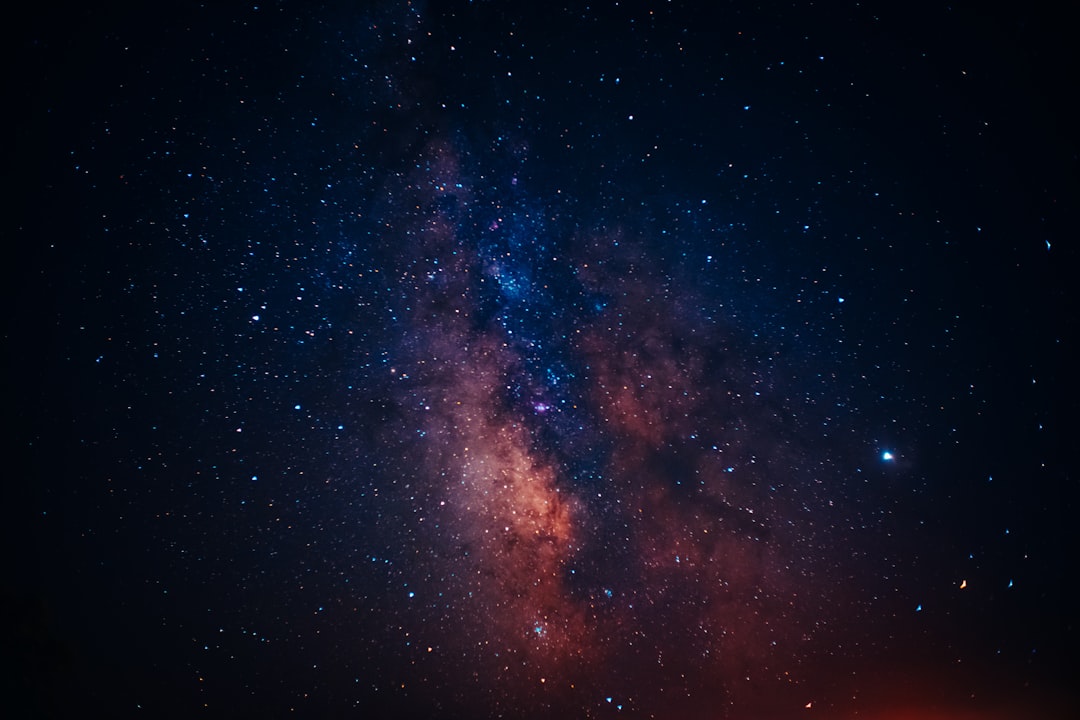
Where would you go to watch a star being born? Probably not the heart of the Milky Way, which is about the most violent neighbourhood our galaxy has to offer — a maelstrom of gas churning so fast and so chaotically that you might think nothing could ever settle there long enough to collapse into a star. And yet stars do form in that turmoil, and astronomers have just begun to work out how, by finding an unexpected pocket of calm buried deep within the chaos.
The discovery, made using the most powerful radio telescope array on Earth, challenges long-held assumptions about where and how star formation can take place — and opens a remarkable window onto the universal processes that have been building stars, including our own Sun, since the earliest epochs of cosmic history.
The Galactic Centre: A Crucible of Chaos
To appreciate why this finding is so remarkable, it helps to understand just how extreme the environment at the Galactic Centre truly is. Sitting roughly 26,000 light-years from Earth, the central region of the Milky Way is unlike anywhere else in our galaxy. At its very core lurks Sagittarius A*, a supermassive black hole with a mass approximately four million times that of our Sun, whose gravitational influence reverberates through the surrounding region on an enormous scale.
Wrapped around this violent core is a vast reservoir of gas and dust known as the Central Molecular Zone (CMZ) — a region spanning roughly 1,000 light-years in diameter that contains the equivalent of tens of millions of solar masses of molecular gas. Despite harbouring so much raw material, the CMZ produces far fewer stars than astronomers would expect based on its gas density alone. For decades, this paradox — an abundance of stellar fuel yet a surprising scarcity of new stars — has puzzled researchers.
The explanation lies in turbulence. In the CMZ, gas clouds are constantly buffeted by supersonic shockwaves, intense magnetic fields, and the gravitational tidal forces exerted by the galaxy's dense central bar. The gas races at velocities far exceeding the local speed of sound — typically around one kilometre per second in such molecular clouds — and churns so violently that gravity struggles to overcome the kinetic energy and compress material into the dense, cold cores from which stars are born.
"Picture a stretch of white water rapids, where nothing can stay still long enough to gather. The galactic centre is, in many ways, the most inhospitable star-forming environment in the entire galaxy."
Under these conditions, the standard model of star formation — in which gravity slowly overwhelms the internal pressure of a cloud, causing it to fragment and collapse — seems almost impossible to apply. And yet, massive stars have been observed forming there, clustered in regions like the Arches Cluster, the Quintuplet Cluster, and the dense molecular cloud complex Sagittarius B2. The mechanism driving their formation has remained one of the outstanding mysteries of modern astrophysics.
ALMA's Record-Breaking Survey
The breakthrough came from a landmark new survey conducted with the Atacama Large Millimeter/submillimeter Array (ALMA), an international facility operated by ESO, NAOJ, and NRAO, perched at an altitude of 5,000 metres on the Chajnantor Plateau in the Chilean Andes. ALMA's extraordinary sensitivity to cold molecular gas — the very substance from which stars are made — makes it uniquely suited to probing the complex chemistry and dynamics of regions like the CMZ.
Led by Rojita Buddhacharya and her collaborators, the survey produced what is described as the largest image ALMA has ever generated, charting dozens of distinct molecular species — including carbon monoxide, hydrogen cyanide, and dense gas tracers — across wide swaths of the galactic centre. By mapping not just the distribution of gas but its velocity structure in extraordinary detail, the team was able to construct a comprehensive picture of the turbulent landscape at the heart of the Milky Way.
The data processing alone represented a formidable challenge. The sheer volume of information encoded in ALMA's radio observations required sophisticated algorithms and considerable computational resources to turn into coherent, scientifically interpretable maps — a challenge that foreshadows the increasingly central role of machine learning in modern observational astronomy.

A Still Pool in the White Water
Tucked inside the roar of the CMZ, the team found something they did not expect: a small, quiet pocket where the gas had slowed below the speed of sound, drifting along gently and smoothly — what physicists call subsonic motion. In the language of the white water rapids analogy, they had found a still pool.
What made this discovery even more compelling was a structure threaded through the heart of that calm region: a long, slender filament of molecular gas. Filaments are known to be critical intermediaries in the star formation process. In the quieter outer regions of the galaxy, astronomers have long observed how gas organises itself into these thread-like structures, which then fragment along their lengths under gravitational instability — a process described theoretically by the Jeans instability criterion — forming a chain of dense clumps that eventually collapse into protostars.
In this newly discovered calm pocket, gravity was found to be strong enough to hold the filament in place and begin that same process of fragmentation. The two essential ingredients for star formation — subsonic gas motion and sufficient gravitational binding — were present simultaneously, in a location where no one had previously thought to look for them.
What surprised the astronomers most was how abruptly the gas switched from chaos to calm — the entire transition playing out across remarkably small distances, suggesting that the boundary between turbulent and quiescent gas can be sharper than theoretical models had predicted.
Why This Changes Our Understanding of Star Formation
Until now, such tranquil stellar nurseries — known in the literature as coherent cores or subsonic envelopes — had only been identified in the relatively placid molecular clouds of the galactic disc, regions like the Taurus Molecular Cloud or the Ophiuchus star-forming region, thousands of light-years from the galactic centre. Finding the same calm conditions even within the extreme environment of the CMZ carries profound implications.
- Universal star formation physics: The discovery suggests that the fundamental process by which stars form may be the same everywhere in the galaxy, regardless of the surrounding environment — a single, universal recipe operating even under the most extreme conditions.
- Resolving the CMZ star formation paradox: It offers a plausible mechanism by which stars can form in the galactic centre despite the overwhelming turbulence — by finding or creating localised pockets of calm within the broader chaos.
- Implications for high-redshift galaxies: The centres of many distant, high-redshift galaxies are thought to resemble the CMZ in their extreme turbulence and density. Understanding how stars form in the Milky Way's own centre may illuminate star formation processes across cosmic history.
- Magnetic field interactions: The sharp transition between turbulent and calm gas hints at possible roles for magnetic fields in locally damping turbulence — a relationship that theorists will now be eager to model in detail.
- A window into our own origins: The gas that eventually became our Sun, roughly 4.6 billion years ago, very likely passed through just such a quiet, subsonic phase before collapsing. In this sense, a corner like this is, quite literally, a glimpse of our own cosmic beginnings.
The Role of Infrared Observatories
Complementing ALMA's radio-wavelength data, infrared observatories have long been essential tools for piercing the dense veil of dust that obscures the galactic centre from optical telescopes. Missions including the Spitzer Space Telescope, the ESA Herschel Space Observatory, and the airborne Stratospheric Observatory for Infrared Astronomy (SOFIA) have produced detailed infrared maps of the galactic centre, revealing the warm dust emission around Sagittarius B1, B2, and C — molecular cloud complexes orbiting Sagittarius A* at distances of roughly 300 light-years.
These infrared datasets, sensitive to the thermal emission from newly forming massive stars as well as cooler dust reservoirs, provide a crucial multi-wavelength context for interpreting ALMA's molecular line maps. Together, they are helping astronomers build a complete, three-dimensional picture of the star formation environment at the galaxy's heart — from the large-scale orbital dynamics of gas streams down to the sub-parsec scales where individual stellar embryos are just beginning to take shape.
Machine Learning and the Search for More Calm Islands
The discovery of this single pocket of calm has already sparked an organised hunt for more. The vast datasets produced by ALMA's galactic centre surveys — containing positional, spectral, and kinematic information for dozens of molecular tracers across millions of pixels — are far too rich to analyse by hand. This is where machine learning and artificial intelligence are poised to play a transformative role.
Algorithms trained to recognise the specific spectral and kinematic signatures of subsonic, gravitationally bound gas could, in principle, automatically flag candidate calm pockets across the entire CMZ. Combined with follow-up observations at higher angular resolution — made possible by ALMA's longest baseline configurations and, in the future, instruments like the Next Generation Very Large Array (ngVLA) — astronomers hope to build a statistical census of these hidden islands of calm and determine what physical conditions give rise to them.
Understanding the frequency of these quiet pockets, and the processes that create or sustain them, will be essential for resolving the broader question of why the CMZ's star formation rate is so much lower than its gas content would suggest — one of the most tantalising open questions in stellar astrophysics today.
A Universal Recipe, Written in Quiet Gas
There is something deeply resonant about the image this research conjures: in the most violent, extreme, and energetic neighbourhood our galaxy has to offer — within the gravitational grip of a four-million-solar-mass black hole, amid supersonic turbulence, magnetic storms, and the relentless tidal shredding of gas clouds — the universe still finds a way to be quiet. Still finds a way to let gravity win, just locally, just briefly, just enough to begin knitting together the atoms that will one day burn as a star.
That this process should follow what appears to be the same fundamental rules seen in the tranquil star-forming clouds of the galactic suburbs is a powerful reminder of the deep universality of physical law. From the calmest corner of a nearby molecular cloud to the turbulent heart of a galaxy, the recipe for building a star is, it seems, always the same: find a quiet place, let gravity gather what it can, and wait.
With ALMA continuing to map the Central Molecular Zone in ever greater detail, and machine learning tools ready to comb through the results, the coming years are likely to reveal many more of these hidden nurseries. Each one will be another data point in humanity's ongoing effort to understand the cosmic processes that built our galaxy, our Sun, and ultimately ourselves.