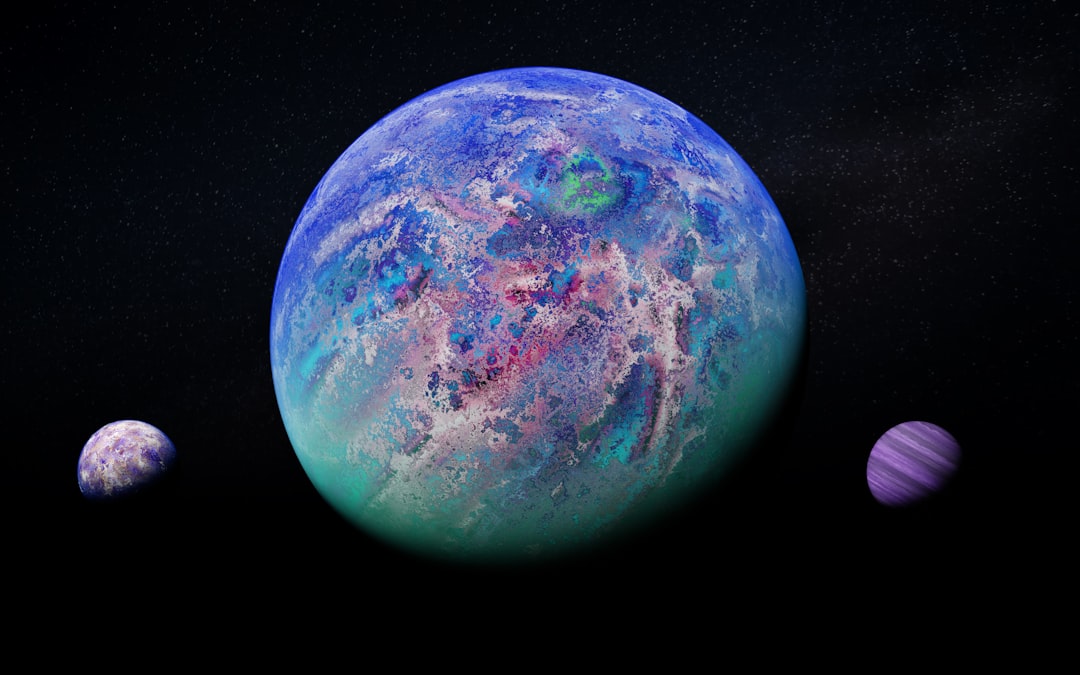
Two Planets Lighter Than Candy Floss: Astronomers Discover Ultra-Low-Density "Super-Puff" Worlds
How flimsy and fluffy can a world truly be? We tend to picture planets as solid, weighty bodies — rocky spheres like Earth or dense gas giants like Jupiter — but astronomers have just discovered two worlds that stretch our very definition of a planet almost to its breaking point. Both are giants, each roughly the size of Jupiter, yet they are so extraordinarily wispy that, gram for gram, they are lighter than candy floss. Scientists call such exotic objects super-puff planets, and finding even one is considered a rare astronomical event. Finding two orbiting the very same star is rarer still — and deeply illuminating.
Named TOI-791 b and TOI-791 c, these two remarkable worlds circle a Sun-like star located some 1,110 light-years away in the southern constellation Volans. Despite swelling to roughly the physical size of Jupiter, they contain almost nothing by comparison. Jupiter packs its enormous bulk into a density of 1.33 grams per cubic centimetre; these two worlds manage barely 0.04 grams per cubic centimetre — approximately thirty times less dense, and lower even than spun sugar at a fairground. They are, in every meaningful sense, planet-shaped clouds.
"Finding two super-puff planets orbiting the same star in a gravitational resonance is extraordinary. These worlds challenge our models of planetary formation and atmospheric evolution in ways we are only beginning to understand."
What Is a Super-Puff Planet?
The term super-puff (sometimes written super-puff or super-puffy) refers to a class of exoplanets with unusually large radii relative to their masses, resulting in densities so low they defy easy comparison to anything in our own Solar System. While our gas giants — Jupiter and Saturn — are themselves far less dense than terrestrial planets, Saturn being the only planet in the Solar System less dense than liquid water, super-puffs take this to an extreme. Most known super-puff planets have densities comparable to expanded polystyrene or, as in the case of TOI-791 b and TOI-791 c, lighter than the airy spun sugar served at fairs and carnivals.
Fewer than a dozen confirmed super-puff planets were known before this discovery, making TOI-791's system an exceptionally valuable natural laboratory. Previously identified super-puffs include planets in the Kepler-51 system, which set the benchmark for just how low planetary density could go. TOI-791 b and TOI-791 c now rank among the least dense planets ever confirmed, pushing theoretical models to their limits and raising profound questions about how such objects form, persist, and evolve over time.
A Delicate Gravitational Dance: Orbital Resonance
Stranger still than their individual properties is the relationship these two siblings share. Born together from the same swirling protoplanetary disc of gas and dust around their young star, they now move in an exquisitely ordered gravitational choreography. For every five complete orbits the inner planet makes around their host star, the outer planet completes almost exactly three — a precise numerical relationship that astronomers call a mean-motion orbital resonance.
Resonances like this are not mere coincidence. They arise when gravitational interactions between planets lock their orbital periods into stable, repeating ratios. Similar resonances are seen in our own Solar System — Jupiter's moons Io, Europa, and Ganymede share a famous 1:2:4 resonance — and among other exoplanetary systems such as TRAPPIST-1, where seven Earth-sized worlds maintain a complex resonant chain. The fact that TOI-791 b and TOI-791 c remain in a 5:3 resonance suggests they have preserved much of the dynamical structure from the earliest epoch of their formation, offering a pristine record of their origins.
As the two planets circle their star, each exerts a gentle but measurable gravitational tug on the other, subtly nudging the precise timing of their transits — the moments when each world crosses the face of its star as seen from Earth. These tiny shifts, measured in minutes, are the gravitational fingerprints of one world upon another. And it was those small deviations from clockwork regularity that ultimately gave the game away.
How the Planets Were Discovered and Weighed
The story of TOI-791 b and TOI-791 c begins with citizen science. The planets were first spotted in data collected by NASA's Transiting Exoplanet Survey Satellite (TESS), a space telescope designed to monitor hundreds of thousands of nearby stars for the characteristic dips in brightness that betray the presence of a transiting planet. The faint signals of these two worlds were initially identified not by professional astronomers, but by dedicated volunteers participating in the Planet Hunters citizen science project — a crowdsourced platform hosted by the Zooniverse collaboration that invites members of the public to sift through astronomical data.
The transit method revealed the planets' sizes: by measuring precisely how much starlight each world blocked as it crossed in front of its host star, astronomers could calculate their physical radii. But size alone does not tell you how much mass a planet contains. To weigh these worlds, the research team employed a sophisticated technique known as Transit Timing Variation (TTV). Because the two planets pull gravitationally on one another, their transits do not occur at perfectly regular intervals; they arrive slightly early or slightly late depending on where each planet is in its orbit relative to the other. By carefully measuring the pattern of these timing deviations over many transit events, scientists can work backwards to determine each planet's mass. Size and mass together yielded the planets' remarkably featherlight densities.
- TOI-791 b and TOI-791 c both have physical radii comparable to Jupiter.
- Their densities are approximately 0.04 g/cm³ — around 30 times less dense than Jupiter.
- For context, liquid water has a density of 1.0 g/cm³; candy floss is estimated at roughly 0.05 g/cm³.
- The pair orbit in a 5:3 mean-motion resonance, a hallmark of an undisturbed, primordially ordered system.
- Each transit lasts more than eleven hours — far longer than most exoplanet transits, which typically last one to three hours.
The Antarctic Advantage: Observing From the Bottom of the World
Confirming and characterising these planets demanded both extraordinary patience and an extraordinary vantage point. Because TOI-791 b and TOI-791 c orbit relatively far from their host star compared to many known exoplanets, each transit event — each crossing of the planetary disc across the stellar face — drags on for more than eleven hours. That duration far exceeds what can be observed in a single night from most observatories on Earth, where the rotation of the planet inevitably brings the Sun back above the horizon before the transit concludes.
The solution lay at the bottom of the world. Astronomers turned to a telescope at Concordia Research Station, a French-Italian scientific outpost situated on the high Antarctic plateau at Dome C, roughly 3,200 metres above sea level. During the austral winter, Concordia experiences months of unbroken polar night — a period of continuous darkness that no mid-latitude observatory can match. Beneath this perpetual darkness, the telescope was able to track an entire eleven-hour transit from start to finish without any interruption from daylight, recording what are believed to be the longest planetary transits ever observed in their entirety from the ground. The extraordinary atmospheric stability and low humidity of the Antarctic plateau further enhanced the precision of these measurements, underscoring Antarctica's growing importance as a site for cutting-edge astronomical observation.
How Do Super-Puff Planets Form?
Perhaps the most compelling question raised by this discovery is also the most fundamental: how does a planet end up this insubstantial? The answer remains the subject of active theoretical debate, but several hypotheses have emerged in recent years, informed by previous super-puff discoveries.
The leading explanation is that super-puffs like TOI-791 b and c are worlds swaddled in enormous, extended atmospheres of hydrogen and helium. According to this model, a modest rocky or icy core — perhaps a few times the mass of Earth — formed in the cold outer reaches of its young solar system, beyond the so-called snow line where temperatures are low enough for volatile compounds to freeze. In this frigid environment, gas could accumulate rapidly around the core, building up a vast, diffuse atmosphere that accounts for much of the planet's volume but contributes surprisingly little to its total mass. The result is an object that looks large but weighs almost nothing — inflated like a cosmic balloon.
A competing idea invokes the presence of high-altitude photochemical hazes — layers of small particles created when ultraviolet radiation from the host star breaks apart molecules in the upper atmosphere, triggering chemical reactions that produce a thick, obscuring smog. Such hazes could make the planet appear larger than it truly is during transit observations, inflating apparent radii and thus deflating calculated densities. Other researchers have proposed that strong atmospheric winds and tidal heating from gravitational interactions with the host star might puff up planetary atmospheres over time. Disentangling these possibilities requires observing the chemical composition of the atmospheres directly.
The James Webb Space Telescope: The Next Frontier
That is precisely where the investigation is headed. The research team now hopes to turn the James Webb Space Telescope (JWST) on both TOI-791 b and TOI-791 c. By observing the system during transit, JWST can analyse the starlight that filters through each planet's atmosphere using a technique called transmission spectroscopy. Different molecules — water vapour, methane, carbon dioxide, ammonia, and others — absorb starlight at characteristic wavelengths, leaving distinct chemical fingerprints in the spectrum. These fingerprints can reveal not only what the atmospheres are made of, but also offer clues about where and how the planets formed.
If the atmospheres are dominated by primordial hydrogen and helium, consistent with gas accreted from the protoplanetary disc at large orbital distances, that would support the cold outer formation hypothesis. If instead the spectra reveal the signatures of photochemical hazes or complex organic molecules, alternative formation and evolution pathways become more plausible. The ESA/NASA Webb telescope, with its unprecedented infrared sensitivity, is uniquely equipped to make such discriminating measurements, having already demonstrated its power to characterise exoplanet atmospheres in remarkable detail.
Wider Significance: Rethinking Planetary Formation
The discovery of TOI-791 b and TOI-791 c carries implications that extend well beyond this single star system. Their existence — particularly the fact that two such extreme worlds formed around the same star and have survived in a stable resonant configuration — places meaningful constraints on planetary formation models and on the diversity of outcomes that the planet-building process can produce.
It also speaks to the extraordinary reach of citizen science. The initial identification of these planets by volunteers in the Planet Hunters project — non-professional astronomers donating their time and attention to the systematic examination of real scientific data — resulted in a discovery with genuine research impact. It is a reminder that in the era of large-scale sky surveys, the human eye and intuition remain powerful tools, and that the boundaries between professional and public participation in science are increasingly porous.
For the broader study of exoplanet atmospheres and demographics, TOI-791 b and c represent valuable new data points at the extreme low-density end of the planetary mass-radius diagram — a region that is poorly sampled and poorly understood. As missions like ESA's CHEOPS and future observatories continue to refine measurements of known exoplanets, and as JWST delivers detailed atmospheric spectra, the picture of how planets of all kinds form and evolve will come into ever sharper focus.
Two of the lightest worlds we have ever found may yet have something extraordinarily weighty to tell us about the universe we inhabit — and about the astonishing variety of forms that a planet can take.
Key Facts at a Glance
- System designation: TOI-791, located ~1,110 light-years away in the constellation Volans
- Planet sizes: Both approximately Jupiter-sized in radius
- Density: ~0.04 g/cm³ — lighter than candy floss (~0.05 g/cm³) and about 30× less dense than Jupiter
- Orbital resonance: 5:3 mean-motion resonance (inner:outer planet)
- Discovery method: Transit photometry via NASA/TESS, with citizen scientists from Planet Hunters
- Mass measurement method: Transit Timing Variations (TTV)
- Transit duration: Over 11 hours — among the longest ground-observed transits on record
- Ground observation site: Concordia Research Station, Antarctic Plateau (Dome C)
- Next steps: Atmospheric characterisation with the James Webb Space Telescope
Further reading: NASA Exoplanet Exploration | NASA TESS Mission | ESA Webb Telescope | ESA CHEOPS Mission | Planet Hunters TESS (Zooniverse)