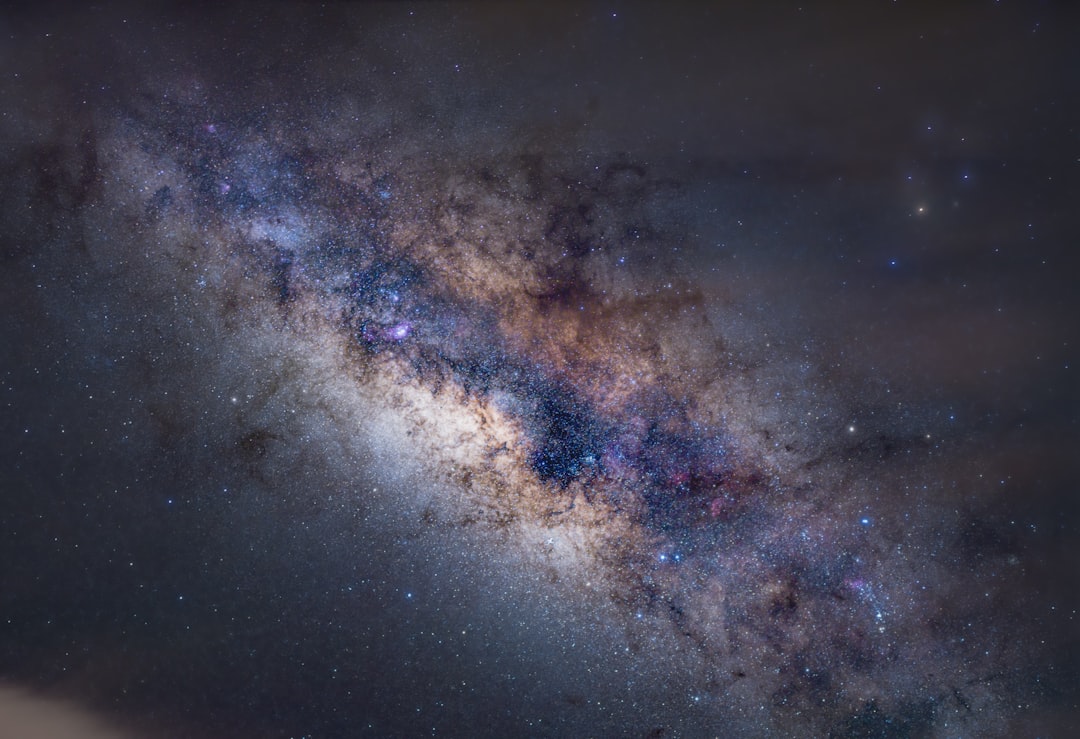
In a groundbreaking achievement that pushes the boundaries of astronomical observation, an international consortium of scientists has unveiled the most detailed radio image ever captured of our galaxy's central region. This unprecedented mosaic, created using the Atacama Large Millimeter/submillimeter Array (ALMA), spans an area equivalent to three full Moons placed side by side and reveals the Central Molecular Zone (CMZ) in extraordinary detail. The image exposes a chaotic, 650-light-year-wide region where extreme conditions govern the birth and death of some of the most massive stars in our galaxy, offering astronomers an unparalleled window into stellar evolution in one of the universe's most hostile environments.
The galactic center, often called the "Bulge" due to its distinctive shape, has long frustrated astronomers attempting to peer through its dense curtains of dust and gas. Traditional optical telescopes are essentially blind to this region, as visible light cannot penetrate the thick clouds of interstellar material. However, radio wavelengths pass through these obstacles with relative ease, allowing instruments like ALMA to reveal what has remained hidden from human eyes since the dawn of astronomy. Beyond the famous supermassive black hole Sagittarius A*, which weighs approximately four million times the mass of our Sun, this central region harbors complex chemistry that may hold crucial clues to understanding how life-enabling molecules form throughout the cosmos.
The research represents the culmination of efforts by the ALMA CMZ Exploration Survey (ACES), a collaborative project involving more than 160 scientists from over 70 institutions spanning six continents. This massive undertaking, described in a series of papers published in the Monthly Notices of the Royal Astronomical Society, demonstrates the power of international scientific cooperation in tackling some of astronomy's most challenging observational targets.
Unveiling the Galaxy's Most Extreme Star-Forming Factory
The Central Molecular Zone represents a cosmic laboratory unlike any other accessible to detailed study. Located approximately 26,000 light-years from Earth, this region contains the highest concentration of dense molecular gas in the Milky Way—roughly 80% of all the galaxy's densest gas compressed into just 2% of its volume. The conditions here are extraordinarily extreme: temperatures soar to millions of degrees in some areas, while others remain frigid at just tens of degrees above absolute zero. Magnetic fields thread through the gas at strengths hundreds of times greater than those found in the Sun's vicinity, and cosmic rays bombard the region with energies that would be lethal to any form of life.
Dr. Ashley Barnes, an astronomer at the European Southern Observatory (ESO), which oversees ALMA operations, emphasized the unique nature of this cosmic environment:
"It's a place of extremes, invisible to our eyes, but now revealed in extraordinary detail. The observations provide a unique view of the cold gas—the raw material from which stars form—within the so-called Central Molecular Zone of our galaxy. It is the first time the cold gas across this whole region has been explored in such detail. It is the only galactic nucleus close enough to Earth for us to study in such fine detail."
The new ALMA dataset reveals intricate filamentary structures of cold molecular gas flowing through the region like cosmic rivers, feeding into dense clumps where new stars ignite. These filaments, some stretching dozens of light-years across, channel material toward gravitational wells where stellar nurseries form. The resolution achieved by ALMA allows astronomers to trace these structures from the largest scales down to individual gas clouds surrounding nascent stars—a range spanning more than three orders of magnitude.
Revolutionary Observational Capabilities and Technological Achievement
The creation of this remarkable image required pushing ALMA to its operational limits. The array, located on the Chajnantor Plateau in Chile's Atacama Desert at an altitude of 16,400 feet, consists of 66 high-precision antennas working in concert to function as a single, enormous telescope. By combining signals from antennas separated by up to 16 kilometers, ALMA achieves angular resolution equivalent to detecting a golf ball on the Moon from Earth.
For the ACES project, astronomers conducted observations across multiple frequency bands, allowing them to detect different molecular species and physical conditions simultaneously. The survey targeted emissions from various molecules, including silicon monoxide (SiO), carbon monoxide in multiple isotopic forms, and complex organic molecules such as methanol and various hydrocarbons. Each molecular tracer provides unique information about temperature, density, velocity, and chemical composition within the gas clouds.
The data processing alone represented a monumental challenge. The raw observations generated petabytes of information that required sophisticated algorithms and substantial computational resources to transform into the final mosaic. The team developed innovative calibration techniques to ensure consistency across the entire survey area, accounting for variations in atmospheric conditions during different observing sessions and the complex geometry of the overlapping pointings needed to create such an expansive image.
Chemical Complexity and Astrobiological Implications
One of ACES's primary objectives involves cataloging the chemical inventory of the galactic center, from simple two-atom molecules to complex organic compounds containing dozens of atoms. This chemical census has profound implications for understanding how the building blocks of life form in space. The survey has already identified numerous prebiotic molecules—compounds that, while not alive themselves, serve as precursors to the chemistry of life as we know it.
The extreme conditions in the CMZ actually accelerate certain chemical processes, creating a natural laboratory for studying chemistry under conditions that may have been common in the early universe. NASA's Spitzer Space Telescope and other infrared observatories have complemented ALMA's findings, revealing that complex organic molecules form readily even in these harsh environments. This discovery challenges earlier assumptions that such delicate chemistry required more benign conditions.
Extreme Stellar Evolution and Galactic Archaeology
Principal Investigator Steven Longmore, who initiated and led the ACES project, emphasized the broader implications of studying star formation in the galactic center:
"The CMZ hosts some of the most massive stars known in our galaxy, many of which live fast and die young, ending their lives in powerful supernova explosions, and even hypernovae. By studying how stars are born in the CMZ, we can also gain a clearer picture of how galaxies grew and evolved. We believe the region shares many features with galaxies in the early Universe, where stars were forming in chaotic, extreme environments."
This comparison to primordial galaxies makes the CMZ invaluable for galactic archaeology—using nearby objects to understand conditions in the distant, early universe. During the cosmic epoch known as the "peak of star formation," which occurred roughly 10 billion years ago, galaxies throughout the universe were producing stars at rates hundreds of times faster than the Milky Way does today. The conditions in those ancient galaxies likely resembled the extreme environment found in our galactic center, making the CMZ a local analog for studying processes that shaped cosmic evolution.
The massive stars born in the CMZ burn through their nuclear fuel in mere millions of years—cosmic eyeblinks compared to the Sun's 10-billion-year lifespan. When these stellar giants die, they explode as supernovae or even more energetic hypernovae, ejecting heavy elements forged in their cores into the surrounding gas. These explosive deaths enrich the interstellar medium with elements like carbon, oxygen, and iron—the raw materials for planets and, potentially, life. The ACES data allows astronomers to trace this cycle of stellar birth, death, and chemical enrichment with unprecedented precision.
Key Scientific Discoveries and Unexpected Revelations
The ACES survey has already yielded several remarkable findings that challenge existing theories:
- Suppressed Star Formation: Despite containing enormous quantities of dense gas—the primary ingredient for star formation—the CMZ produces new stars at a rate roughly ten times lower than expected based on conditions in the galaxy's outer disk. This "star formation deficit" suggests that additional factors, possibly related to strong magnetic fields or turbulent gas motions, inhibit the gravitational collapse necessary for stellar birth.
- Velocity Structures: The detailed velocity measurements reveal gas moving at speeds exceeding 100 kilometers per second, driven by supernova explosions, stellar winds from massive stars, and gravitational interactions with the central black hole. These supersonic flows create shock waves that compress gas, potentially triggering star formation in some regions while disrupting it in others.
- Chemical Gradients: The distribution of different molecular species varies dramatically across the CMZ, with certain complex molecules concentrated in specific regions. This chemical segregation provides clues about temperature variations, radiation fields, and the history of stellar activity throughout the central region.
- Filament Networks: The mosaic reveals an intricate web of filamentary structures far more complex than anticipated. These filaments appear to channel gas flows over vast distances, connecting different star-forming regions and possibly regulating the overall rate of stellar birth in the galactic center.
Comparative Galactic Studies and Universal Implications
The ACES findings enable meaningful comparisons with observations of distant galactic nuclei. The James Webb Space Telescope has recently begun observing the centers of galaxies billions of light-years away, where conditions may resemble those in our own galactic center. By understanding the detailed physics and chemistry in the CMZ, astronomers can better interpret observations of these remote systems, where individual star-forming clouds cannot be resolved even with the most powerful telescopes.
Furthermore, the study of the CMZ provides crucial context for understanding active galactic nuclei (AGN)—extremely luminous galactic centers powered by actively feeding supermassive black holes. While Sagittarius A* currently consumes material at a relatively modest rate, evidence suggests it was far more active in the past. The ACES data may help astronomers understand how gas flows toward and feeds supermassive black holes, a process central to galaxy evolution throughout cosmic history.
Future Prospects and Next-Generation Observations
The ACES survey represents just the beginning of a new era in galactic center studies. Dr. Barnes outlined the exciting possibilities that lie ahead:
"The upcoming ALMA Wideband Sensitivity Upgrade, along with ESO's Extremely Large Telescope, will soon allow us to push even deeper into this region—resolving finer structures, tracing more complex chemistry, and exploring the interplay between stars, gas, and black holes with unprecedented clarity. In many ways, this is just the beginning."
The ALMA Wideband Sensitivity Upgrade, scheduled for completion in the coming years, will increase the array's instantaneous bandwidth by a factor of four, dramatically improving its ability to detect faint molecular lines and survey large areas efficiently. This enhancement will enable follow-up studies that probe even deeper into the chemical complexity of the CMZ and track how gas properties change over time.
Meanwhile, the Extremely Large Telescope (ELT), currently under construction in Chile, will complement ALMA's radio observations with unprecedented optical and infrared capabilities. With a primary mirror 39 meters in diameter—the largest optical telescope ever built—the ELT will resolve individual stars within the densest parts of the CMZ, allowing astronomers to study stellar populations and their interactions with the surrounding gas in exquisite detail.
The combination of these next-generation facilities promises to answer fundamental questions about how stars form under extreme conditions, how supermassive black holes influence their host galaxies, and how the chemistry necessary for life develops in the cosmos. The ACES dataset has laid the foundation for decades of future research, providing a comprehensive baseline against which future observations can be compared to detect changes and evolution in this dynamic region.
As astronomers continue to analyze the wealth of data from this landmark survey, new discoveries are certain to emerge. Each finding brings us closer to understanding not only our own galaxy's heart but also the processes that have shaped cosmic evolution from the earliest epochs of the universe to the present day. The journey into the Milky Way's central regions has only just begun, and the view revealed by ALMA promises to keep astronomers busy for years to come.