Astronomers Witness the Transformation of a Centaur into a Comet
At the crossroads between the rocky inner solar system and the frigid outer reaches lie some of the most scientifically compelling objects astronomers have ever studied: the Centaurs. These enigmatic bodies, orbiting the Sun in the vast gravitational arena between Jupiter and Neptune, are now yielding extraordinary secrets about one of planetary science's most fundamental questions — how do icy bodies become comets? A groundbreaking new study, leveraging the unparalleled power of the James Webb Space Telescope (JWST) and the Gemini North Observatory, has captured this transformation in unprecedented detail.
What Are Centaurs? The Solar System's In-Between Objects
Named after the half-human, half-horse creatures of Greek mythology, Centaurs are aptly described as hybrid objects — neither fully asteroid nor fully comet. They occupy a dynamically unstable region of the solar system, with orbits that cross those of the giant planets. This gravitational instability means that, on astronomical timescales, no Centaur stays in its current orbit forever. Each one is eventually either shepherded inward toward the Sun by a close planetary encounter, or scattered outward into the cold oblivion of the Oort Cloud or interstellar space.
Compositionally, Centaurs straddle a fascinating boundary. They are not as rocky and thermally processed as the bodies of the Main Asteroid Belt, which have spent billions of years basking in relatively warm solar radiation. Nor are they as pristine and deeply frozen as the Kuiper Belt Objects (KBOs) that drift silently beyond Neptune, where temperatures plunge below –220°C. Instead, Centaurs represent a kind of intermediate state — icy, yet partially activated, sitting in a thermal sweet spot that makes them ideal laboratories for studying cometary evolution.
"Centaurs are the missing link between the cold, dormant ice-rich populations of the outer solar system and the active, tail-bearing comets we observe in the inner solar system. Studying them is like watching planetary evolution in real time."
According to NASA's planetary science resources, there are likely hundreds of thousands of Centaurs larger than 1 kilometer in diameter, though only a few hundred have been formally catalogued. Their transient nature makes them exceptionally valuable windows into the early solar system's composition and the dynamic processes that continue to shape it today.
The Subject of Study: Active Centaur 450P/LONEOS
The star of this new research is 450P/LONEOS, a Centaur with a particularly dramatic recent history. In 1992, this object experienced a close gravitational encounter with Saturn that fundamentally altered its orbital trajectory. Prior to this encounter, 450P/LONEOS moved on a more distant, quieter path through the outer solar system. The Saturnian flyby, however, delivered a powerful gravitational "nudge" that reshaped its orbit, pulling its closest approach to the Sun — its perihelion — inward to approximately the orbital distance of Jupiter, roughly 5 astronomical units (AU) from the Sun.
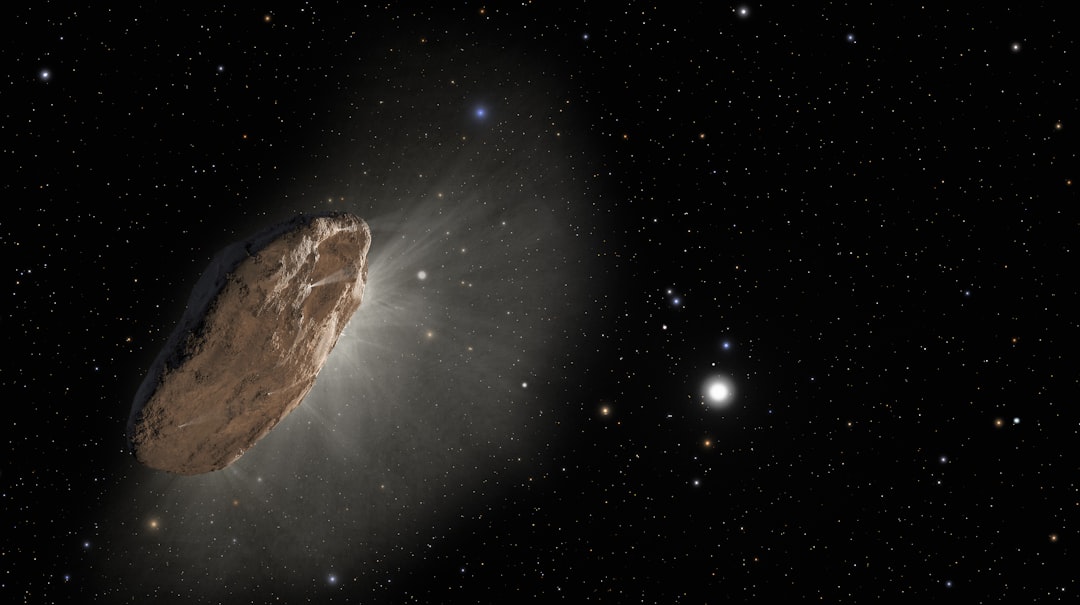
This orbital shift had a profound consequence: 450P/LONEOS began to "wake up." As it moved into its new, warmer perihelion zone, the object started exhibiting the hallmarks of cometary activity — venting volatile gases and developing a visible dust and vapor tail. It was no longer a passive, dormant icy rock. It was transitioning into something new.
The team, led by Charles A. Schambeau and colleagues, used JWST's extraordinary infrared sensitivity alongside Gemini North's powerful optical and near-infrared capabilities to characterize both the nucleus and the coma — the cloud of gas and dust surrounding the object — of 450P/LONEOS in extraordinary detail. Their findings, published in The Planetary Science Journal, challenge some long-held assumptions about cometary composition and activation.
A Surprising Lack of Water: Rethinking the "Dirty Snowball"
For decades, the dominant model of cometary composition has been the "dirty snowball" hypothesis, first proposed by astronomer Fred Whipple in 1950. In this framework, comets are essentially loose agglomerations of water ice mixed with dust and rocky material. As a comet approaches the Sun, solar radiation sublimates the water ice, releasing gas and dust that form the iconic glowing tail. Water vapor, in this model, should be the dominant volatile species observed in a newly activating cometary body.
Yet when Schambeau's team took spectroscopic observations of the coma and tail of 450P/LONEOS, the results were startling. The tail contained almost no detectable water vapor. Instead, the dominant volatile species was carbon dioxide (CO₂) — essentially dry ice — rather than water ice. This finding has significant implications for our understanding of how icy bodies are activated as they migrate toward the inner solar system.
- Water vapor (H₂O) was nearly absent from the observed coma of 450P/LONEOS, contrary to standard cometary models.
- Carbon dioxide (CO₂) was the dominant volatile driving the observed cometary activity.
- The presence of ice crystals in the dust tail was confirmed, suggesting a dynamic and evolving internal structure.
- The object's activity began well before it reached its closest approach to the Sun, consistent with CO₂-driven sublimation, which occurs at much greater heliocentric distances than water ice sublimation.
- The findings align with theoretical models suggesting that CO₂ is often the primary driver of cometary activity at distances beyond 3–4 AU from the Sun.
This is consistent with what planetary scientists have observed in other cometary bodies at large solar distances. Carbon dioxide sublimates at much lower temperatures than water ice, meaning it can drive activity far from the Sun — exactly the environment in which Centaurs like 450P/LONEOS find themselves. The ESA's Rosetta mission, which orbited Comet 67P/Churyumov-Gerasimenko for over two years, similarly found that CO₂ and carbon monoxide were dominant drivers of activity at larger heliocentric distances.
Amorphous Ice and the Mechanism of Activation
So why so little water, and where does the carbon dioxide come from? The research team proposes a compelling physical explanation rooted in the structure of ice itself. Much of the frozen water within Centaur 450P/LONEOS is likely stored in an amorphous, porous form — a disordered, glass-like state of ice that forms at extremely low temperatures and traps other volatile gases, including CO₂, within its molecular structure.
As the object migrates closer to the Sun and its surface begins to warm, this amorphous ice undergoes a phase transition, reorganizing itself into a more ordered crystalline ice structure. This crystallization process is exothermic — it releases energy — and critically, it expels the trapped CO₂ gas from within the ice matrix. The liberated carbon dioxide then drives the outgassing and tail formation observed by the team, without requiring the direct sublimation of water ice at all.
This model is elegantly supported by the observational data. Spectral analysis of the dust tail of 450P/LONEOS revealed the presence of ice crystals — the very crystalline water ice predicted to form as the amorphous phase transforms. It is, in essence, a physical fingerprint of the activation process, caught in the act by JWST's powerful instruments. More information about how the James Webb Space Telescope probes the composition of solar system bodies can be found at the Webb Space Telescope official site.
The Road Ahead: Future Evolution of 450P/LONEOS
The story of 450P/LONEOS is far from over. The research team highlights two plausible evolutionary pathways that could further transform this object's cometary character in the future.
First, if 450P/LONEOS experiences another close gravitational encounter — this time with Jupiter — it could be deflected into an even tighter orbit around the Sun, bringing it into the inner solar system as a true Jupiter-family comet. At closer heliocentric distances, solar radiation would be intense enough to directly sublimate the crystalline water ice on and near the object's surface. The result would be a dramatic enrichment of the comet's tail with water vapor, producing a more "classic" cometary signature consistent with Whipple's original dirty snowball model.
Second, even without a further orbital shift, the repeated passage of 450P/LONEOS through its current perihelion will gradually exhaust its accessible CO₂ reserves. After many orbits, when the more easily released dry ice has been largely vented, the tail's composition could shift naturally toward water-vapor dominance as the comet's activity digs deeper into its icy interior. This evolutionary pathway would represent a chemical stratification of the nucleus — a layered depletion of volatiles from the most easily released to the most thermally stubborn — playing out over millennia of orbital cycles.
Understanding these pathways is critical for interpreting the broader population of short-period comets we observe today. Many of the comets regularly visiting the inner solar system — including famous examples like Halley's Comet — are thought to have originated as Centaurs or Kuiper Belt Objects before being gravitationally herded inward. The observations of 450P/LONEOS effectively provide a snapshot of this process in its earliest stages.
Broader Implications for Planetary Science
Beyond the specifics of 450P/LONEOS, this study carries sweeping implications for our understanding of solar system dynamics and the origins of cometary material. Comets are often described as the time capsules of the solar system — preserving pristine ices and organics from the era of planetary formation some 4.6 billion years ago. Understanding the compositional evolution they undergo as they migrate from the cold outer solar system to the warm inner solar system is essential for correctly interpreting what these ancient messengers are actually telling us about early solar system chemistry.
The role of CO₂ as a primary activation agent — rather than water — may also have implications for the study of cometary contributions to Earth's early oceans and atmosphere. If Centaur-to-comet transitions are predominantly CO₂-driven in their early stages, it refines models of what volatile species these bodies would have delivered to the terrestrial planets during the period of heavy bombardment in the early solar system. For more on the importance of comets to planetary science and astrobiology, the NASA Planetary Science Division offers an extensive range of resources.
The JWST observations of 450P/LONEOS also demonstrate the telescope's remarkable power as a solar system science tool — not just a window into the distant cosmos. By combining JWST's unmatched infrared spectroscopy with Gemini North's complementary capabilities, the team was able to dissect the chemical composition of a faint, distant object in ways that were simply not possible before this generation of instruments. This bodes extremely well for future studies of Centaur populations and other transitional solar system bodies. The Gemini Observatory's science program continues to be a pivotal partner in such multi-facility investigations.
Conclusion
The observations of 450P/LONEOS represent a landmark moment in our understanding of cometary evolution. For the first time, astronomers have been able to watch — in chemical and structural detail — the early stages of an icy Centaur awakening into a comet, driven not by the sublimation of water ice as long assumed, but by the release of trapped carbon dioxide from within a transforming amorphous ice matrix. It is a story of gradual, inexorable change — of a frozen wanderer, nudged by gravity across centuries, slowly finding its voice as a comet.
As JWST continues to train its golden mirrors on the solar system's most intriguing inhabitants, studies like this one promise to fundamentally reshape our picture of how the solar system's icy inventory has evolved — and continues to evolve — over the grand sweep of astronomical time.
Reference: Schambeau, Charles A., et al. "JWST and Gemini Observations of the Active Centaur 450P/LONEOS: Nucleus and Coma Characterizations." The Planetary Science Journal 7.6 (2026): 137.