Astrophoto: Jupiter Captured by Amateur Astronomer Paul F. Campbell
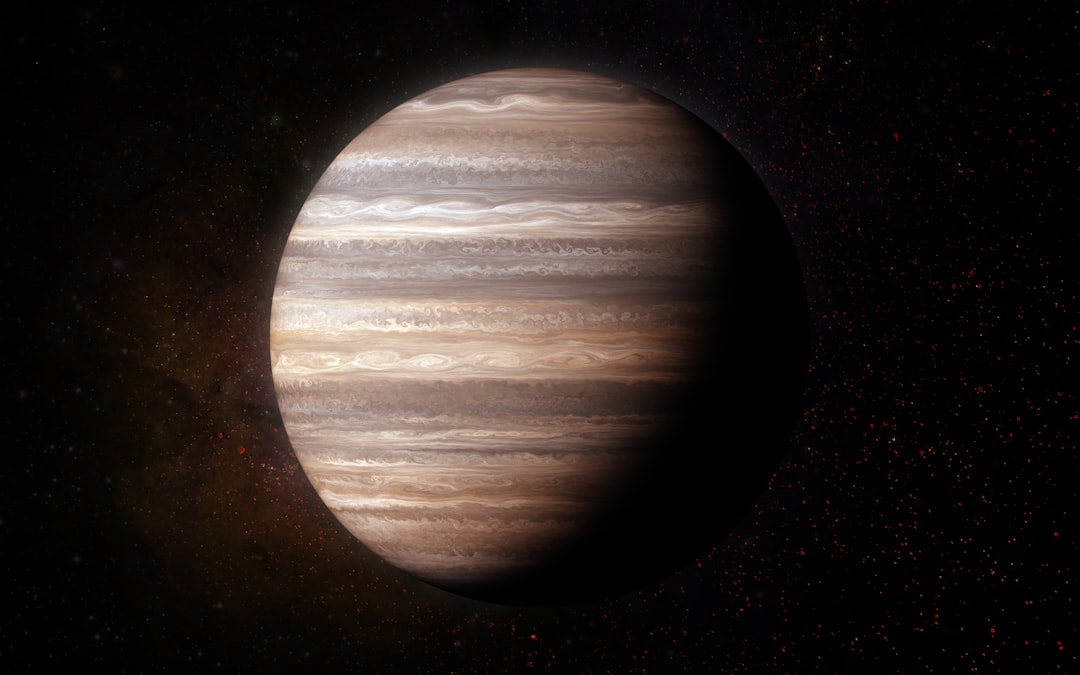
Amateur astronomer and astrophotographer Paul F. Campbell captured this stunning image of Jupiter from just outside his home in Washington, PA, demonstrating the remarkable capabilities available to dedicated backyard astronomers today. The image stands as a testament to how accessible deep-sky and planetary imaging has become in the modern era, with relatively modest equipment yielding results that would have required professional-grade observatories just a few decades ago.
Equipment and Technique
Campbell used a Meade ETX AutoStar telescope operating in polar mode — a configuration in which the mount's primary axis is aligned parallel to Earth's rotational axis, allowing the telescope to compensate precisely for the planet's apparent motion across the sky. This particular instrument had been specially modified and "supercharged" by the renowned amateur astronomy expert Dr. Clay Sherrod, whose performance upgrades are well known in the amateur astronomy community for dramatically improving tracking accuracy and optical performance.
For image capture, Campbell employed a SAC 7 CCD camera operated through AstroVideo software. Rather than capturing a single still frame — which would be subject to atmospheric distortion and noise — he recorded a one-minute video at a frame rate of 1/50th of a second per frame. This technique, known as Lucky Imaging or video stacking, is widely used in planetary photography because it generates hundreds of individual frames from which only the sharpest, least atmosphere-distorted images can be selected and combined.
The video was subsequently processed using Registax 3, a powerful freeware application purpose-built for astronomical image stacking and alignment. By mathematically aligning and averaging the best frames, Registax dramatically improves signal-to-noise ratio and resolves finer planetary detail. Campbell then performed final post-processing and clean-up in Adobe Photoshop, applying sharpening and contrast adjustments to bring out subtle surface features.
About Jupiter: The Solar System's Giant
Jupiter is the largest planet in our Solar System, with a mass more than twice that of all other planets combined. Composed primarily of hydrogen and helium, it is classified as a gas giant and lacks a solid surface. Its diameter of approximately 142,984 km at the equator makes it more than 11 times the width of Earth, and its immense gravitational influence plays a crucial role in shaping the dynamics of the entire Solar System.
"Jupiter is in many ways a miniature solar system unto itself — with dozens of moons, a powerful magnetic field, and atmospheric dynamics that rival anything we see on Earth." — NASA Jet Propulsion Laboratory, Jupiter Mission Overview
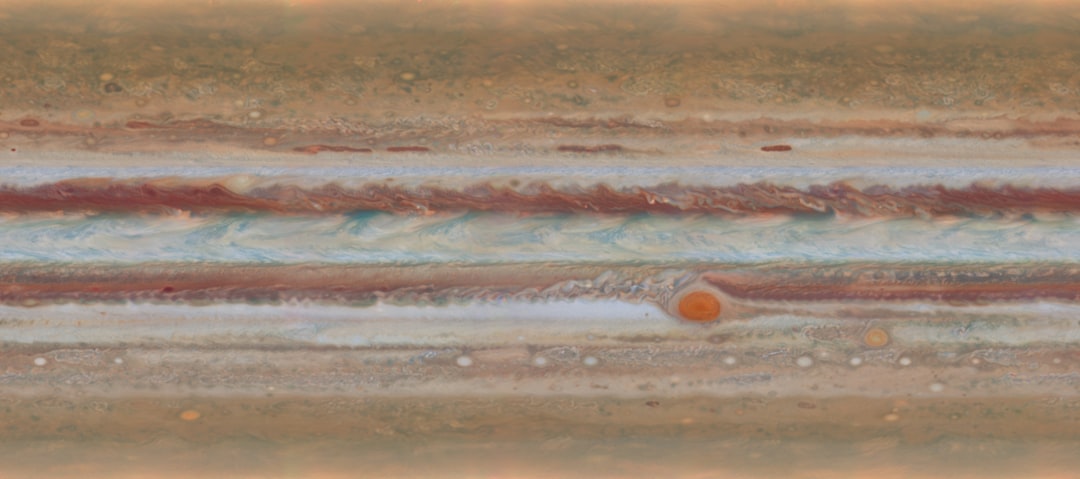
Among Jupiter's most iconic and recognizable features is the Great Red Spot, a persistent anticyclonic storm that has raged for at least 350 years and is large enough to swallow the entire Earth. Even in amateur images like Campbell's, Jupiter's distinctive equatorial cloud bands — alternating light zones and dark belts driven by powerful jet streams — are clearly discernible, offering a window into the planet's complex atmospheric chemistry and dynamics.
Key Facts About Jupiter
- Diameter: ~142,984 km (equatorial) — over 11× Earth's diameter
- Mass: ~1.898 × 10²⁷ kg — approximately 318 Earth masses
- Rotation period: ~9 hours 55 minutes — the fastest rotation of any planet in the Solar System
- Orbital period: ~11.86 Earth years
- Known moons: 95 confirmed moons, including the four large Galilean moons: Io, Europa, Ganymede, and Callisto
- Atmospheric composition: ~89% molecular hydrogen, ~10% helium, with traces of methane, ammonia, and water vapor
- Magnetic field: The strongest of any planet — approximately 20,000 times stronger than Earth's
Why Jupiter Is a Favorite Among Amateur Astronomers
Jupiter is one of the most rewarding targets for amateur planetary imagers. Its sheer size and relative proximity — it can come as close as 588 million km to Earth at opposition — means that even modest telescopes can resolve its cloud bands, the Great Red Spot, and the Galilean moons in a single field of view. The planet's rapid rotation (a Jovian day lasts less than 10 hours) means surface features visibly shift position over the course of a single observing session, making it a dynamic and engaging subject for long-term monitoring.
Images like Campbell's also contribute meaningfully to the broader astronomical community. Citizen science programs, such as those coordinated by the NASA Juno Mission, actively encourage amateur astronomers to submit Jupiter observations that complement data gathered by professional spacecraft. Amateur observations help track transient atmospheric phenomena that professional observatories might miss.
The Art and Science of Planetary Imaging
The workflow Campbell employed — video capture, stacking in Registax, and refinement in Photoshop — represents the gold standard pipeline for amateur planetary photography. Atmospheric seeing, the turbulence caused by pockets of air at different temperatures bending light as it passes through Earth's atmosphere, is the primary limiting factor in ground-based planetary imaging. By capturing video and selecting only the frames taken during moments of steady air, imagers can sidestep the worst effects of poor seeing and achieve near-diffraction-limited resolution even with modest apertures.
For anyone interested in learning more about Jupiter's science and ongoing exploration, the following resources are invaluable:
- NASA Solar System Exploration: Jupiter Overview
- NASA Juno Mission to Jupiter
- ESA JUICE Mission (Jupiter Icy Moons Explorer)
- HubbleSite: Hubble's Latest Views of Jupiter
- The Planetary Society: Jupiter
Share Your Own Astrophotography
Are you an amateur astrophotographer inspired by images like Paul Campbell's? The community of backyard astronomers is thriving and welcoming. Whether you're imaging with a smartphone, a DSLR, or a dedicated CCD camera, your contributions matter — both artistically and scientifically. Visit the Universe Today community forums to share your images, exchange techniques, and connect with fellow enthusiasts. Outstanding submissions may even be featured in the Universe Today newsletter, reaching tens of thousands of astronomy enthusiasts worldwide.