Future Martian Colonists Will Need a New Relativistic Clock
We tend to think of atomic clocks as the ultimate arbiters of time — the gold standard of precision measurement, accurate to within a single picosecond (one trillionth of a second). Yet even these extraordinary instruments are not immune to the fundamental laws of physics. Specifically, they remain subject to the warping effects of Einstein's General Theory of Relativity, which dictates that the passage of time is not a universal constant but rather a quantity that bends, stretches, and shifts depending on the local strength of gravity and the velocity of the observer. Place an atomic clock on a different planet, and it will quietly begin to drift — ticking slightly faster or slower than its counterpart back on Earth, depending on the depth of that planet's gravitational well.
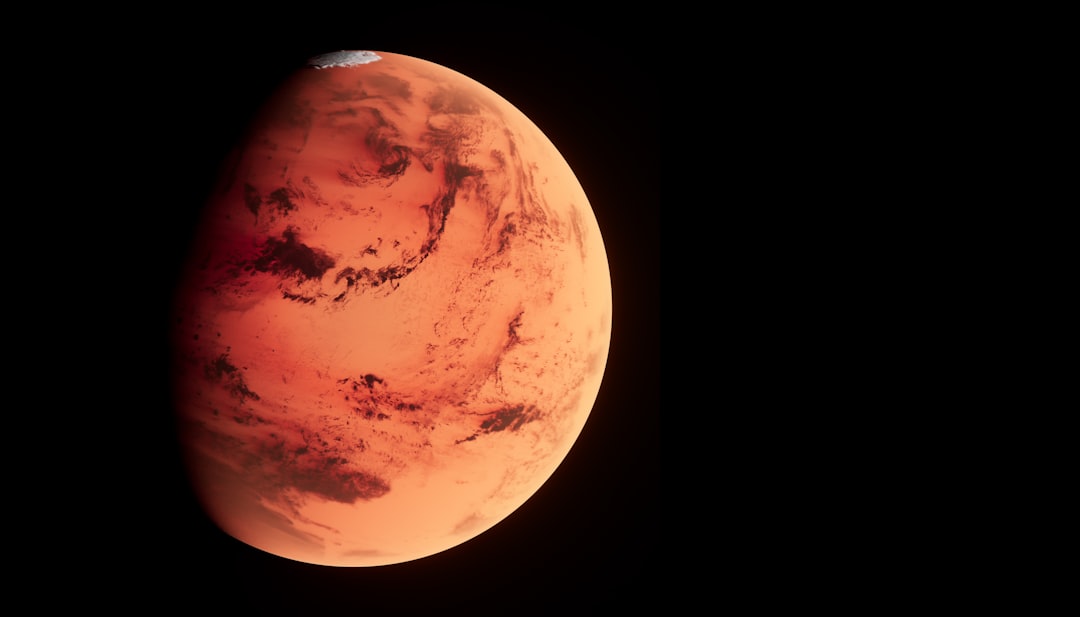
In the case of Mars, the situation is particularly significant for future exploration and colonization planning. The Red Planet is less massive than Earth, possessing only about 38% of Earth's surface gravity, meaning that Mars sits in a shallower gravitational well. According to general relativity, clocks in weaker gravitational fields tick faster than those in stronger ones — a phenomenon known as gravitational time dilation. This means that an atomic clock sitting on the Martian surface would gradually run ahead of an identical clock on Earth, accumulating timing discrepancies that, while minuscule on human timescales, become critically important for precision navigation, satellite communications, and the kind of robust technological infrastructure that any long-term human presence on Mars would require.
Now, Dr. Slava Turyshev, a researcher at NASA's Jet Propulsion Laboratory (JPL), has taken a decisive step toward solving this problem. In a new paper available as a pre-print on arXiv, Dr. Turyshev proposes a comprehensive relativistic timekeeping framework specifically designed for Mars — one that could eventually underpin everything from rover navigation to interplanetary communications networks.
Introducing Areocentric Coordinate Time
At the heart of Dr. Turyshev's proposal is a new timescale he calls Areocentric Coordinate Time (TCA) — a Martian analogue to Geocentric Coordinate Time (TCG), the relativistic timescale currently used for Earth-based precision measurements. The name draws on Areo-, the Greek prefix relating to Ares, the god of war after whom Mars is named, lending the framework a fitting classical gravitas.
Rather than building the TCA framework in isolation, Dr. Turyshev anchors it within the well-established Barycentric Celestial Reference System (BCRS) and its associated timescale, Barycentric Coordinate Time (TCB), both of which are standardized and maintained by the International Astronomical Union (IAU). The BCRS defines coordinates relative to the center of mass — or barycenter — of the entire Solar System, providing a universal reference frame that transcends any single planet or satellite. By connecting TCA to this Solar System-wide standard, the new paper establishes what Dr. Turyshev describes as a complete mathematical pipeline: a seamless chain of transformations that could, in principle, convert the time shown on an astronaut's wristwatch on the Martian surface all the way back to the Solar System's gravitational center.
"By anchoring Martian timekeeping within the BCRS/TCB formalism, we create a coherent, relativistically consistent framework that can support precision navigation, satellite operations, and surface activities simultaneously — a critical step toward any sustained human presence on Mars."
— Dr. Slava Turyshev, NASA Jet Propulsion Laboratory
This kind of multi-level, hierarchical timekeeping is not a new concept — Earth has used a similar architecture for decades, underpinning GPS satellites, deep-space navigation, and pulsar timing arrays. The innovation here lies in applying that same rigorous relativistic machinery to another world entirely, accounting for Mars's unique gravitational environment, orbital dynamics, and even its volatile seasonal atmosphere.
The Precision Threshold: Where Physics Becomes Irrelevant
No timekeeping system, however sophisticated, can account for every conceivable physical effect. The universe is replete with gravitational perturbations, tidal forces, and quantum mechanical fluctuations, each of which technically influences the rate at which a clock ticks. To keep the framework manageable and practical, Dr. Turyshev applies a carefully chosen precision threshold: any effect that alters a clock's timekeeping by less than 5 × 10⁻¹⁸ — equivalent to an accumulated error of just 0.1 picoseconds — is deemed negligible and excluded from the calculations.
To appreciate just how extraordinarily fine this threshold is, consider this: 0.1 picoseconds is the time it takes light — the fastest thing in the universe — to travel just 0.03 millimeters. In other words, the framework is designed to be accurate to a distance shorter than the width of a human hair. Any physical process too faint to disturb the clock even by that infinitesimal amount is simply set aside, allowing scientists and engineers to focus on the effects that actually matter in practice.
Time Dilation at Different Martian Altitudes
One of the most powerful demonstrations of the TCA framework comes from applying it to satellites and spacecraft operating at various distances from the Martian surface. Just as Earth's GPS satellites must apply relativistic corrections to their onboard clocks to maintain accuracy, any future Martian satellite network will face the same challenge — but with a different set of numbers rooted in Mars's unique gravitational environment.
Low Mars Orbit
A spacecraft operating in Low Mars Orbit (LMO) — roughly the Martian equivalent of the Low Earth Orbit (LEO) where many of our communications and Earth observation satellites currently reside — must travel at extremely high velocities to maintain its approximately 300-kilometer altitude. According to Dr. Turyshev's calculations, this high orbital speed causes a phenomenon known as velocity-induced time dilation (a consequence of Special Relativity), which partially counteracts but ultimately overwhelms the gravitational time dilation effect. The net result is that a clock aboard an LMO satellite will tick 4.56 microseconds slower per day than a clock sitting on the Martian surface. Over weeks, months, and years of continuous operation, these discrepancies compound into meaningful navigation and communication errors — the kind that could, in a worst-case scenario, send a rover off course or corrupt a critical data relay.
Areostationary Orbit
Further out, at Areostationary Orbit (ASO) — the Martian equivalent of Earth's geostationary belt, where a satellite's orbital period matches Mars's rotation so that it appears fixed in the sky — the dynamics reverse. At this greater distance, the gravitational pull from Mars is weaker and orbital velocities are much lower, meaning both gravitational and velocity-based time dilation effects favor faster ticking. Clocks aboard areostationary satellites will tick 9.13 microseconds faster per day than surface clocks. This might sound like a bonus, but uncorrected, it would introduce exactly the same kinds of navigation and synchronization errors as the LMO case — just in the opposite direction.
Highly Elliptical Relay Orbits
The most computationally demanding challenge for the TCA framework lies in highly elliptical relay orbits — the looping, elongated trajectories often used for communications relay satellites that must periodically swing close to a planet's polar regions and then arc far out into deep space. In these orbits, a spacecraft's altitude, velocity, and gravitational environment are continuously changing, meaning that the rate of its clock is constantly shifting as well. Static corrections simply cannot work here. Instead, scientists and engineers must calculate a spacecraft's proper time — the actual time elapsed as measured by the spacecraft's own clock in its own reference frame — at each individual step along its orbit. The TCA framework provides the mathematical tools to do exactly this, offering a rigorous foundation for managing timekeeping across the full spectrum of Martian orbital regimes.
Mars's Gravity: A Lumpy, Shifting Field
One of the most scientifically fascinating aspects of Dr. Turyshev's paper is its detailed treatment of Mars's non-uniform gravitational field — a factor that introduces additional layers of complexity into any relativistic timekeeping scheme.
Unlike a perfectly smooth sphere, Mars is a geologically complex world with towering volcanoes, vast canyon systems, and significant variations in crustal thickness that cause its gravitational field to be lumpy and irregular. To capture these variations accurately, Dr. Turyshev employs the GMM-3 gravity field model — one of the most detailed mathematical representations of Mars's gravitational structure currently available, derived from decades of orbital tracking data from missions such as NASA's Mars Reconnaissance Orbiter.
Using this model, the paper reveals some striking specific effects. The most notable is the contribution of Mars's equatorial bulge — a slight thickening of the planet's midsection caused by its rotation — which introduces a periodic time signature of approximately 87 picoseconds for a low-altitude satellite each time it crosses the equatorial region. This periodic signal must be tracked and corrected for continuously to maintain precision timing.
The Sun's Tidal Influence and Orbital Eccentricity
Mars's own orbital dynamics add yet another layer of complexity. Unlike Earth, which has a nearly circular orbit, Mars has a significantly eccentric orbit — its distance from the Sun varies by roughly 42 million kilometers between its closest approach (perihelion) and its farthest point (aphelion). When Mars swings to perihelion, it enters a region of stronger solar gravity, intensifying the Sun's quadrupole tidal field — the differential gravitational stretching of space around Mars caused by slight variations in the Sun's gravitational pull across the planet's diameter. This tidal effect becomes sufficiently pronounced near perihelion that it requires point-by-point calculations to prevent navigation errors accumulating for both surface rovers and orbital spacecraft.
The Moons of Mars: Phobos and Deimos
Even the two small, irregularly shaped moons of Mars — Phobos and Deimos — find a place in the TCA framework. Under most circumstances, the gravitational influence of these diminutive worlds is utterly negligible. However, as Dr. Turyshev notes, any spacecraft that passes in close proximity to either moon must account for the subtle but non-trivial gravitational perturbations they introduce. A spacecraft making a close flyby of Phobos, for instance, would experience a brief but measurable shift in its local spacetime geometry, introducing a timing error that — if left uncorrected — would propagate forward through all subsequent navigation calculations.
The Wild Card: Martian Weather and the CO₂ Cycle
If the gravitational complexities of Mars's topography, orbital eccentricity, and moons weren't enough, the planet's remarkable seasonal atmosphere introduces what may be the most unpredictable challenge of all for Martian timekeeping.
Mars experiences a dramatic and planet-wide carbon dioxide cycle that has no true parallel on Earth. During Martian winter in each hemisphere, temperatures plummet so severely that atmospheric CO₂ — which makes up roughly 95% of Mars's thin atmosphere — actually freezes out and is deposited directly onto the polar ice caps as dry ice. In Martian summer, this process reverses: the polar dry ice sublimates back into the atmosphere, temporarily thickening it and redistributing enormous quantities of mass across the planet's surface and atmosphere.
This seasonal migration of CO₂ — involving hundreds of billions of tonnes of gas shifting back and forth across the planet twice per Martian year — is not merely a meteorological curiosity. It actually measurably alters Mars's gravitational field, redistributing mass in ways that shift the local curvature of spacetime and therefore affect the rate at which clocks tick in different regions. In principle, this means that an accurate timekeeping framework for Mars must account not just for the planet's static gravitational structure, but for how that structure changes with the seasons.
Unfortunately, as Dr. Turyshev acknowledges in the paper, our current scientific understanding of these seasonal gravitational shifts is not yet detailed enough to incorporate them accurately into a timekeeping model. The observational data needed to characterize the full spatial and temporal evolution of Mars's CO₂ cycle with sufficient precision simply does not yet exist. As a result, he concludes that a true sub-picosecond timing array on Mars — one that could maintain synchronization across the full range of surface and orbital environments — remains beyond reach for the foreseeable future. That is not a failure of the framework itself, but rather a reminder of how much we still have to learn about the Martian environment.
Why This Work Matters Now
It would be easy to look at a paper about picosecond-level timekeeping on Mars and conclude that this is a problem for another generation. After all, humanity has not yet set foot on the Red Planet, let alone built the kind of technological infrastructure that would demand such precision. But Dr. Turyshev's paper makes a compelling case for starting this foundational work now rather than later.
Consider the history of Earth's own timekeeping infrastructure. The relativistic corrections built into the GPS Global Positioning System were not an afterthought — they were the product of decades of theoretical groundwork in general and special relativity, combined with careful experimental verification long before the first GPS satellite was ever launched. Had those corrections not been incorporated from the beginning, GPS would have accumulated positioning errors of roughly 10 kilometers per day, rendering it useless for navigation within hours of activation.
The same principle applies to Mars. As agencies like NASA and ESA develop increasingly ambitious plans for robotic and eventually crewed Mars missions, the communications, navigation, and surface operations systems they design will need to incorporate relativistic timekeeping from the ground up. A mismatch in time standards between a surface habitat, an orbital relay satellite, and a mission control team back on Earth could cascade into navigation failures, data corruption, or missed communication windows — costly at best, potentially catastrophic at worst.
"It's better to get started now than to come to terms with it only after a mismatch in the understanding of time leads to a system failure."
— Dr. Slava Turyshev, on the urgency of developing Martian timekeeping standards
Key Takeaways from the TCA Framework
- Areocentric Coordinate Time (TCA) provides a rigorous, relativistically consistent timescale for Mars, anchored within the IAU's Solar System-wide reference framework.
- Clocks in Low Mars Orbit tick approximately 4.56 microseconds slower per day than surface clocks due to high