In the ongoing quest to determine the precise age of our cosmos, astronomers have long grappled with a fundamental question: what exactly causes the light from distant galaxies to shift toward the red end of the spectrum? This seemingly simple observation, first documented by Edwin Hubble in the late 1920s, has profound implications for our understanding of cosmic history. While the prevailing interpretation points to an expanding universe, alternative explanations have challenged this view throughout the past century, forcing scientists to rigorously test the foundations of modern cosmology.
This article continues our exploration of cosmic age determination, diving deep into one of the most controversial alternatives to the expanding universe model: the tired light hypothesis. As we'll discover, the distinction between observing galaxies "moving away" versus observing their light "becoming redshifted" represents far more than semantic hairsplitting—it opens the door to fundamentally different interpretations of cosmic structure and evolution.
The Critical Distinction: Redshift Versus Recession
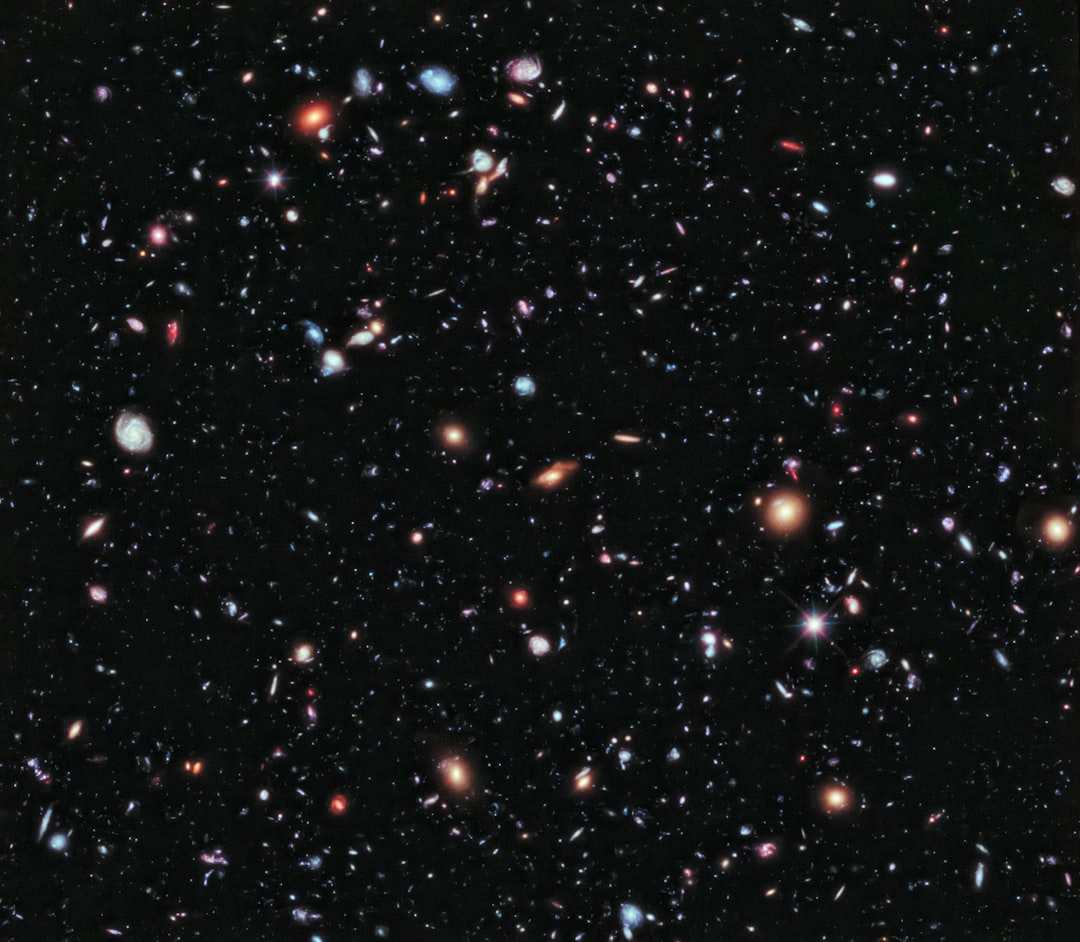
When astronomers peer into the depths of space using instruments at facilities like the Hubble Space Telescope, they don't directly measure galaxies fleeing from us. Instead, they observe something more subtle: the spectral lines of light from distant galaxies appear shifted toward longer, redder wavelengths compared to the same lines measured in terrestrial laboratories. This phenomenon, known as cosmological redshift, serves as the cornerstone observation upon which our understanding of universal expansion rests.
The standard cosmological model interprets this redshift as evidence that space itself is expanding, stretching the wavelengths of light as photons traverse the vast cosmic distances. However, this interpretation isn't the only logically possible explanation—it's simply the one that has survived the most rigorous scientific scrutiny. The crucial detail that demands explanation is the distance-redshift relationship: galaxies twice as far away exhibit twice the redshift, galaxies three times as distant show three times the redshift, and so on.
If we naively interpret redshift as simple Doppler motion—galaxies physically flying through space away from us—we encounter an immediate puzzle. Why would galaxies at greater distances somehow "know" they need to move faster? This would require an extraordinary cosmic conspiracy, with distant objects coordinating their velocities based on their distance from Earth. Such geocentric special pleading contradicts the Copernican principle, which holds that our location in the universe isn't privileged or special.
Enter Fritz Zwicky: The Maverick Astronomer
Few scientists in the 20th century matched the brilliance—or the abrasiveness—of Fritz Zwicky. This Swiss-American astronomer made groundbreaking contributions to our understanding of the cosmos, including coining the term "supernova" and providing some of the earliest observational evidence for dark matter through his studies of the Coma Cluster. His work on gravitational lensing predictions preceded observational confirmation by decades.
Yet Zwicky was equally famous for his confrontational personality. His legendary feuds with colleagues at the California Institute of Technology became the stuff of academic lore. When he told Nobel laureate Robert Millikan—who also happened to be his superior—that he had "never found a single original idea" in Millikan's work, it exemplified Zwicky's willingness to challenge authority regardless of personal consequences.
This contrarian streak extended to his scientific work. Deeply skeptical of the emerging consensus around cosmic expansion, Zwicky sought alternative explanations for the observed redshift phenomenon. His solution, proposed in the 1920s and refined over subsequent decades, became known as tired light theory.
The Tired Light Hypothesis: An Alternative Vision
The core premise of tired light theory is elegantly simple: perhaps photons lose energy as they travel through space, not because space is expanding, but due to some intrinsic property of light or the cosmic medium through which it propagates. As photons lose energy, their wavelength increases (shifts toward the red), mimicking the effect we attribute to cosmic expansion. This would allow the universe to remain static and eternal, avoiding the philosophically troubling implication of a cosmic beginning.
According to research documented in the Astrophysical Journal, several mechanisms were proposed for this energy loss, including interactions with intergalactic matter, quantum effects in the vacuum of space, or gravitational interactions with distant matter. Each proposal attempted to explain redshift without invoking expansion.
"The tired light hypothesis represented a serious challenge to the expanding universe model in its early years. It wasn't dismissed lightly—it required extensive observational evidence to conclusively rule out," notes Dr. Virginia Trimble, astronomer and science historian at the University of California, Irvine.
The Formidable Obstacles Facing Tired Light
While conceptually appealing to those uncomfortable with cosmic expansion, tired light theory faces a gauntlet of observational and theoretical challenges. For the hypothesis to work, it must satisfy an increasingly stringent set of requirements:
- Selective Distance Dependence: The energy loss mechanism must only operate over cosmological distances (millions to billions of light-years) while leaving light from nearby sources unaffected. No known physical process exhibits this behavior.
- Wavelength Independence: The mechanism must affect all wavelengths equally—from high-energy gamma rays to low-frequency radio waves. This proves extraordinarily difficult to achieve, as most physical processes interact differently with different photon energies.
- Image Preservation: Any scattering or interaction process would blur distant galaxy images, yet observations from instruments like the James Webb Space Telescope show remarkably sharp images of galaxies at extreme distances, ruling out scattering mechanisms.
- Non-linear Scaling: At extreme distances, the relationship between distance and redshift becomes non-linear in specific ways predicted by expansion models. Tired light must reproduce this exact relationship through different physics.
- Compatibility with General Relativity: Einstein's theory predicts that a static universe filled with matter would gravitationally collapse. Tired light must either modify general relativity or invoke additional physics to maintain stability.
- Quantum Mechanical Consistency: Both quantum mechanics and special relativity forbid photons from spontaneously losing energy without interaction. Any tired light mechanism must overcome this fundamental prohibition.
Observational Evidence Against Tired Light
Modern observations have erected even more formidable barriers to tired light models. The cosmic microwave background radiation, discovered in 1965, provides powerful evidence for a hot early universe—a prediction of expansion models that tired light cannot naturally explain. Studies conducted by missions like ESA's Planck satellite have mapped this radiation with extraordinary precision, confirming predictions of the expanding universe model to remarkable accuracy.
Furthermore, observations of Type Ia supernovae at various distances reveal that these stellar explosions appear to occur in "slow motion" when viewed at great distances—exactly as predicted if the universe is expanding and time itself is dilated at high redshifts. Tired light models cannot account for this time dilation effect, which has been confirmed through detailed light curve analysis of distant supernovae.
The distribution of galaxy ages and the evolution of cosmic structure also pose severe challenges. In an expanding universe, we expect to see younger, less evolved galaxies when we look to greater distances (and thus further back in time). Observations confirm this prediction. A static tired light universe would show no such systematic evolution, contradicting what we observe.
Why Tired Light Persists in Popular Discussion
Despite overwhelming evidence against it, tired light theory occasionally resurfaces in popular discussions and fringe scientific literature. This persistence stems partly from the genuinely counterintuitive nature of cosmic expansion—the idea that space itself stretches challenges our everyday experience. Additionally, some individuals uncomfortable with the Big Bang model's implications for cosmic origins find tired light appealing as an alternative that permits an eternal universe.
However, the scientific community has moved decisively past tired light. It's not that the hypothesis has been formally "proven wrong" in an absolute sense—science rarely works through definitive proofs. Rather, every specific tired light model proposed has failed to match observations, while the expanding universe model has passed test after test with flying colors.
The Expanding Universe: Last Theory Standing
With tired light and other alternative explanations eliminated, the Friedmann-Lemaître-Robertson-Walker (FLRW) metric emerges as the framework that best describes our cosmos. This mathematical description of an expanding universe, derived from Einstein's general relativity, provides a "universal clock" that allows us to speak meaningfully about the age of the universe.
The FLRW metric makes specific, testable predictions about how the universe should appear at different epochs, how structures should form and evolve, and how various cosmological observables should relate to one another. Time and again, from the cosmic microwave background to the large-scale distribution of galaxies, observations have confirmed these predictions.
Yet science never rests on its laurels. Even as the expanding universe model stands triumphant over alternatives like tired light, cosmologists continue probing its foundations. What if the metric itself contains errors or approximations? What if our understanding of cosmic expansion needs refinement? These questions drive ongoing research and lead us to the next chapter in our exploration of cosmic age determination.
Looking Ahead: Questioning the Metric
The story of tired light teaches us an important lesson about scientific progress: good ideas aren't enough. A hypothesis must survive confrontation with observation, must make testable predictions, and must prove more successful than alternatives at explaining the full range of available data. Tired light failed these tests not because scientists were biased against it, but because nature refused to cooperate with its predictions.
As we continue this series on the age of the universe, we'll next examine whether the FLRW metric itself might require modification. Could there be subtleties in how we apply general relativity to the cosmos? Might quantum effects or other physics beyond Einstein's theory influence our age calculations? The quest to understand our cosmic timeline continues, building on the hard-won knowledge that tired light doesn't work, but always remaining open to new evidence and ideas.
The universe, it seems, is neither tired nor static—it's dynamic, evolving, and continues to surprise us with its complexity and beauty.