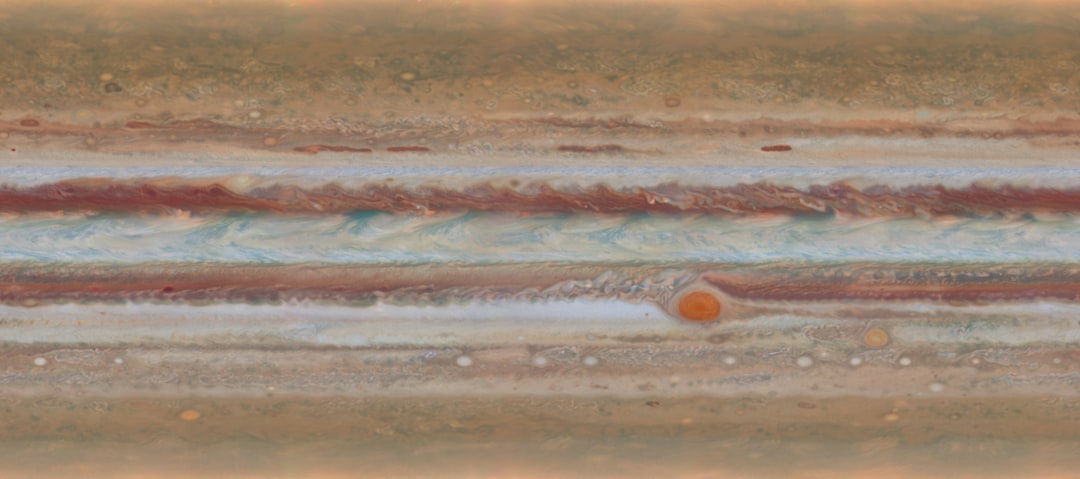
The gas giant Jupiter has captivated humanity's imagination for centuries, its turbulent atmosphere displaying a kaleidoscope of colors and patterns visible even through modest Earth-based telescopes. Yet beneath the mesmerizing bands of clouds and the iconic Great Red Spot lies a realm of mystery that has challenged planetary scientists for decades. Recent computational breakthroughs are now pulling back the veil on Jupiter's hidden interior, revealing surprising insights about the chemical composition and dynamic processes that drive the largest planet in our solar system.
A groundbreaking study published in The Planetary Science Journal on January 8 has unveiled unexpected findings about Jupiter's atmospheric chemistry, particularly regarding its oxygen abundance. The research, conducted by a collaborative team spanning NASA and leading academic institutions, employed sophisticated computer modeling techniques to probe the enigmatic interior mechanisms of this colossal world. Their discoveries not only reshape our understanding of Jupiter itself but also carry profound implications for how we comprehend planetary formation throughout the cosmos.
The findings are particularly remarkable given the technological journey that brought us here. Since NASA's Juno spacecraft entered orbit around Jupiter on July 4, 2016, our perspective on this giant planet has undergone a revolutionary transformation. The spacecraft's close-up observations have revealed atmospheric phenomena of breathtaking complexity—from massive lightning storms crackling through the clouds to intricate polar vortices swirling at the planet's extremes. Yet understanding the fundamental chemistry driving these spectacular features has remained frustratingly elusive, until now.
Unveiling Jupiter's Chemical Secrets Through Advanced Modeling
The research team's approach represents a significant leap forward in computational planetary science. By combining two complementary modeling techniques—a one-dimensional chemistry-based model and a two-dimensional hydrodynamic model—the scientists created an unprecedented simulation of Jupiter's interior atmospheric dynamics. This dual-pronged methodology allowed them to examine both the chemical reactions occurring within the atmosphere and the physical movements of gases throughout the planet's vast interior.
The results proved startling: Jupiter contains approximately one and a half times more oxygen than our Sun. While this might seem counterintuitive given that Jupiter is composed primarily of hydrogen and helium—the same elements that dominate the Sun—the enhanced oxygen abundance provides crucial clues about the planet's formation history. In the context of Jupiter's overall composition, oxygen remains a trace element, but even small variations in such "heavy elements" can fundamentally alter our understanding of how and where giant planets form.
"This is a long-standing debate in planetary studies," explained Dr. Jeehyun Yang, a postdoctoral researcher at the University of Chicago and lead author of the study. "It's a testament to how the latest generation of computational models can transform our understanding of other planets."
Perhaps equally significant, the team discovered that atmospheric circulation patterns within Jupiter move much more slowly than previous models had suggested. This finding challenges decades of assumptions about how heat and materials are transported through the planet's deep atmosphere. The slower circulation rates imply that mixing processes occur over longer timescales, which has important ramifications for understanding Jupiter's internal heat budget and the longevity of atmospheric features like its famous storms.
The Formation Puzzle: What Jupiter's Oxygen Tells Us About Planetary Birth
The enhanced oxygen content discovered in Jupiter's atmosphere serves as a chemical fingerprint from the planet's birth, approximately 4.6 billion years ago. According to current planetary formation theories, the amount and distribution of heavy elements like oxygen in a gas giant depend critically on where and how the planet formed within the primordial solar nebula. Two competing scenarios have dominated scientific discourse for years.
In the first scenario, Jupiter formed relatively close to its current position, beyond the "snow line" where water ice could condense. In this model, the planet would have accreted significant amounts of ice-coated solid material, which would later evaporate and enrich the atmosphere with oxygen-bearing compounds like water vapor. The second scenario suggests Jupiter might have formed much farther out in the solar system before migrating inward, potentially encountering different chemical environments that would leave distinct signatures in its atmospheric composition.
The new findings provide crucial constraints for these competing theories. The specific oxygen-to-hydrogen ratio measured through the models helps narrow down the possible formation locations and mechanisms. This information is invaluable not only for understanding our own solar system's history but also for interpreting observations of exoplanetary systems, where gas giants are commonly detected orbiting distant stars.
Implications for Exoplanet Science
Jupiter serves as the archetype for understanding gas giant exoplanets throughout the galaxy. Astronomers have discovered thousands of Jupiter-like worlds orbiting other stars, many in configurations vastly different from our solar system. Some orbit extremely close to their parent stars as "hot Jupiters," while others follow elongated, eccentric paths. By establishing a detailed chemical and physical profile of Jupiter, scientists gain a reference point for interpreting observations of these distant worlds.
The atmospheric composition data becomes particularly relevant when analyzing exoplanet atmospheres using techniques like transmission spectroscopy, where starlight filtering through a planet's atmosphere reveals its chemical makeup. Understanding Jupiter's oxygen abundance and circulation patterns helps calibrate the models used to decode these distant atmospheric signatures, potentially revealing whether exoplanets formed through similar or different processes than our solar system's giants.
Juno's Revolutionary Discoveries: Rewriting the Jovian Textbook
The new atmospheric modeling study builds upon a foundation of remarkable discoveries made by the Juno mission since its arrival at Jupiter. The spacecraft's suite of scientific instruments has penetrated deeper into Jupiter's mysteries than any previous mission, fundamentally altering our conception of the planet's structure and behavior.
Among Juno's most surprising findings is the discovery that Jupiter's polar regions host multiple large vortices arranged in geometric patterns, a stark contrast to Saturn's single polar vortex. These cyclones, some larger than Earth itself, maintain remarkably stable configurations despite the turbulent atmospheric conditions. The mechanisms sustaining these polar structures remain an active area of research, with the new circulation models potentially offering insights into their longevity.
Perhaps even more revolutionary was Juno's revelation that Jupiter may lack a distinct solid core. Instead, the planet appears to possess what scientists describe as a "fuzzy core"—a diffuse region where heavy elements are mixed with hydrogen rather than forming a discrete rocky center. This discovery challenges traditional models of giant planet formation and suggests that Jupiter's interior may have experienced significant mixing events during its history, possibly triggered by massive collisions with other planetary bodies during the solar system's chaotic early period.
Exploring the Galilean Moons: Bonus Science from Juno
While Juno's primary mission focuses on Jupiter itself, the spacecraft has also conducted valuable flybys of the planet's four large Galilean moons, each a world of scientific fascination in its own right:
- Io: Juno's close encounters have captured unprecedented images of Io's extreme volcanic activity, documenting eruptions that dwarf anything seen on Earth. The moon's surface, constantly resurfaced by sulfurous lava flows, provides insights into tidal heating processes that occur when gravitational forces flex a moon's interior.
- Europa: The spacecraft's measurements revealed that Europa's ice shell varies significantly in thickness across different regions, with important implications for the subsurface ocean believed to exist beneath the frozen crust. These findings inform planning for future missions like NASA's Europa Clipper, which will investigate the moon's potential habitability.
- Ganymede: Juno confirmed that Ganymede possesses its own intrinsic magnetic field, making it the only moon in the solar system with this characteristic. This magnetic field creates a miniature magnetosphere within Jupiter's much larger magnetic environment, producing complex interactions that Juno's instruments have begun to unravel.
- Callisto: Despite being composed largely of ice and rock with minimal geological processing, Juno's data suggests Callisto exhibits signs of internal activity. This unexpected finding challenges assumptions about which factors determine whether an icy moon remains geologically active or dormant.
Advanced Computational Techniques: The Future of Planetary Science
The study's success highlights the growing importance of computational modeling in planetary science. As observational data from missions like Juno accumulates, sophisticated computer simulations become essential tools for interpreting measurements and testing hypotheses about planetary interiors that cannot be directly observed.
The one-dimensional chemistry model employed in this research simulates the vertical distribution of chemical species within Jupiter's atmosphere, tracking how compounds form, break apart, and react as conditions change with depth. Meanwhile, the two-dimensional hydrodynamic model captures the horizontal and vertical movement of atmospheric gases, including the complex convection patterns that transport heat from Jupiter's interior to space.
By integrating these complementary approaches, the research team could explore how chemical processes and physical dynamics interact within Jupiter's atmosphere. This methodology represents a significant advance over previous studies that typically examined chemistry or dynamics in isolation. The success of this integrated approach suggests similar techniques could be applied to studying other giant planets in our solar system and beyond, potentially revolutionizing our understanding of these enigmatic worlds.
Looking Ahead: Juno's Final Chapter and Future Exploration
Juno's mission has been extended through September 2025, with operations planned to continue until the spacecraft either exhausts its fuel supply or experiences a critical system failure. When that time comes, NASA will deliberately command Juno to plunge into Jupiter's atmosphere, ensuring the spacecraft doesn't accidentally contaminate the potentially habitable environments of Europa or other moons with Earth microbes. This protective protocol follows precedents set by the Galileo spacecraft at Jupiter in 2003 and the Cassini mission at Saturn in 2017.
Until then, every orbit brings new opportunities for discovery. Juno's elliptical path carries it from close approaches that skim just above Jupiter's cloud tops to distant vantage points that provide global perspectives on the planet's atmospheric dynamics. Each pass generates terabytes of data that will keep scientists busy for years to come, even after the mission concludes.
The insights gained from combining Juno's observations with advanced computational models like those described in the recent study exemplify the synergy between observation and theory in modern planetary science. As our modeling capabilities grow more sophisticated and our observational techniques more refined, we can expect continued revelations about Jupiter's interior mechanisms and their implications for understanding planetary systems throughout the universe.
Future missions may build upon Juno's legacy with even more ambitious goals. Concepts under consideration include atmospheric probes that could descend deep into Jupiter's clouds, directly sampling the chemical composition at various depths, or orbiters equipped with advanced radar systems capable of probing even deeper into the planet's interior structure. Such missions would provide ground truth for validating and refining the computational models that are transforming our understanding of giant planets.
The question of what processes occur deep within Jupiter's atmosphere—generating the spectacular storms, jet streams, and color bands we observe—continues to drive scientific inquiry. Each new discovery, whether from spacecraft observations or computational breakthroughs, brings us closer to comprehending the complex interplay of chemistry, physics, and dynamics that makes Jupiter the magnificent world we see today. As we refine our understanding of our solar system's largest planet, we simultaneously sharpen our ability to interpret the diverse menagerie of giant planets being discovered around other stars, expanding our cosmic perspective one calculation and observation at a time.